

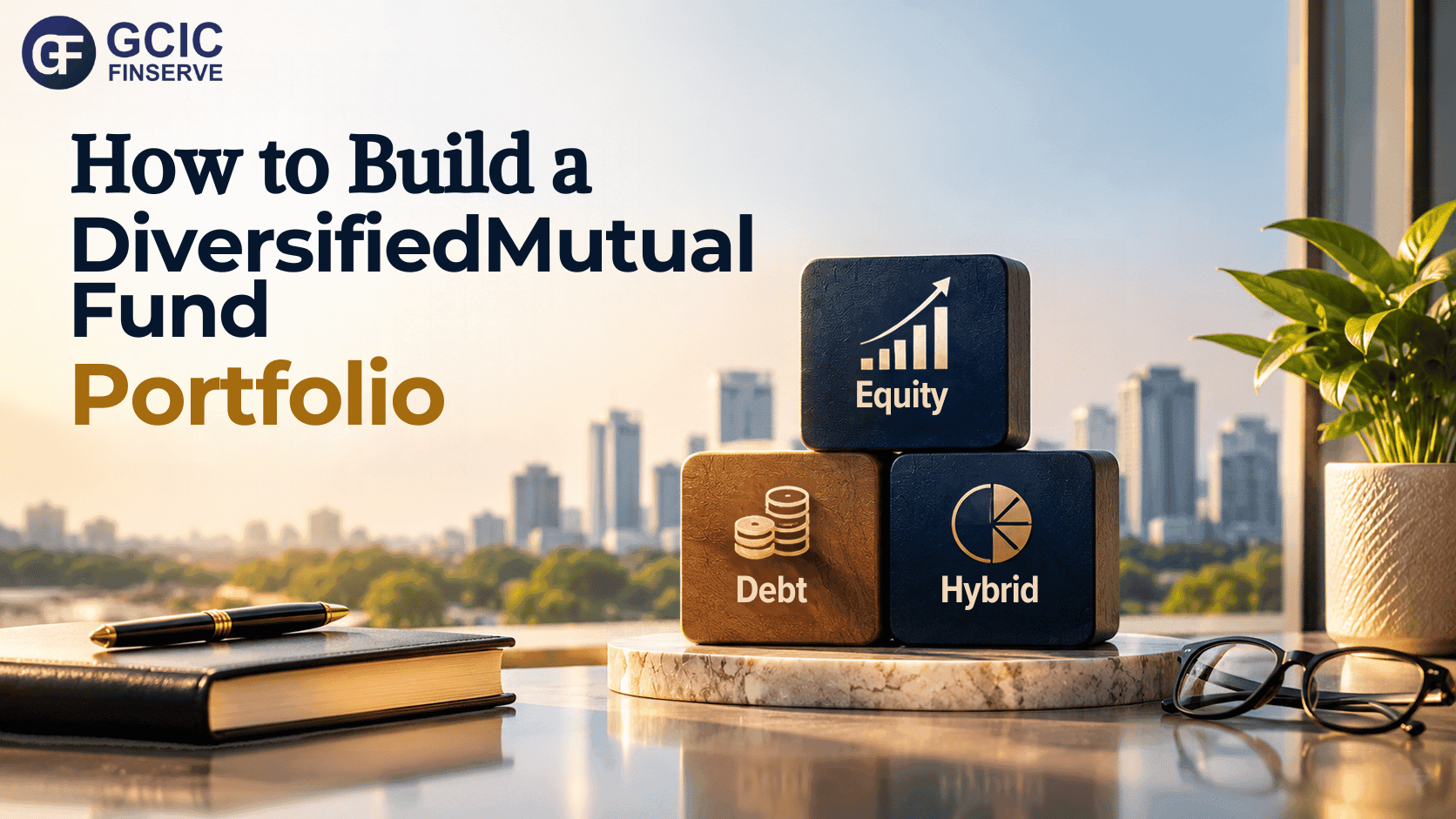
Building a Diversified Mutual Fund Portfolio is about spreading investments across suitable fund categories, asset classes, and investment strategies instead of depending entirely on one investment. Diversification may help manage concentration risk, but it cannot eliminate market risk or guarantee returns.
For investors in Delhi NCR, including South Delhi, Greater Kailash, Defence Colony, Saket, Gurgaon, and Noida, understanding portfolio diversification can be an important step towards becoming a more informed investor.
A well-structured portfolio begins with understanding your financial goals, investment horizon, risk tolerance, and financial circumstances—not simply selecting funds based on recent returns.
What Is a Diversified Mutual Fund Portfolio?
A diversified mutual fund portfolio spreads investments across different asset classes and investment categories to avoid excessive concentration in one area.
Depending on an investor's circumstances, different mutual fund categories may offer exposure to:
- Equity Funds: Invest primarily in shares of companies and carry market-related risks.
- Debt Funds: Invest primarily in fixed-income securities and carry credit and interest-rate risks.
- Hybrid Funds: Combine different asset classes, depending on the scheme's investment strategy.
- Index Funds: Track a specified market index, subject to tracking error and market risk.
Having multiple mutual funds does not automatically mean a portfolio is diversified. Different schemes may have overlapping holdings or similar investment strategies.
Why Is Portfolio Diversification Important?
1. Helps Manage Concentration Risk
Investing heavily in one market segment, sector, or investment style may increase concentration risk.
Diversification spreads exposure across different investments, which may help reduce the impact of underperformance in a single area. However, losses can still occur across diversified investments.
2. Supports Different Financial Goals
Investors may have multiple goals, including retirement planning, children's education, purchasing a home or long-term wealth creation.
Each goal may have a different timeline, financial requirement and risk consideration. Organising investments around individual goals can make portfolio planning more structured.
3. Encourages Disciplined Investment Decisions
Diversification encourages investors to evaluate the overall portfolio rather than chase the latest outperforming scheme.
A portfolio should be assessed based on its purpose, risk, investment horizon, and suitability—not only recent returns.
How to Build a Diversified Mutual Fund Portfolio
Step 1: Define Your Financial Goals
Identify why you are investing and when you may need the money.
Short-term, medium-term and long-term financial goals may require different investment considerations.
Step 2: Understand Your Risk Profile
Assess your willingness and ability to handle investment fluctuations.
Risk tolerance is not determined by age alone. Financial responsibilities, income stability, existing assets, liabilities and investment experience can also influence your risk profile.
Step 3: Understand Different Fund Categories
Learn how equity, debt, hybrid and other mutual fund categories operate.
Understand their investment objectives, underlying holdings, liquidity considerations and risks before evaluating them.
Step 4: Avoid Overlapping Investments
Holding several mutual fund schemes with similar portfolios may not provide meaningful diversification.
Review scheme holdings and investment strategies to understand whether different funds actually provide different exposures.
Step 5: Evaluate Scheme Information
Before investing, review relevant information such as:
- Scheme investment objective
- Portfolio composition
- Benchmark
- Expense ratio
- Riskometer
- Fund strategy
- Historical performance across different periods
Past performance should not be treated as an indicator or guarantee of future performance.
Step 6: Review Your Portfolio Periodically
Financial goals, personal circumstances and market movements can change over time.
Periodic portfolio reviews can help investors assess whether their investments remain aligned with their objectives. Changes should be considered carefully, including applicable taxes, exit loads and transaction costs.
Common Mutual Fund Diversification Mistakes
Investors should be mindful of common mistakes such as:
- Investing in too many funds without understanding their holdings.
- Choosing schemes only because of recent high returns.
- Ignoring asset allocation and concentration.
- Overlooking debt fund credit and interest-rate risks.
- Taking more risk than they can financially or emotionally manage.
- Making frequent portfolio changes based on short-term market movements.
- Failing to review changing financial goals.
A simpler portfolio with understood investments may be easier to monitor than a complicated portfolio containing numerous overlapping schemes.
Mutual Fund Research Resources for Delhi NCR Investors
Investors searching for mutual fund information, investment education or a mutual fund distributor near me can start by understanding their financial requirements and learning about different mutual fund categories.
GCIC Finserve provides mutual fund information and investment-related resources for investors in South Delhi and Delhi NCR.
Explore our Mutual Funds section to learn about mutual fund categories and available resources.
You can also use our Scheme Performance Tool to explore scheme performance information. Performance should always be considered along with scheme risks, investment objectives and other relevant factors.
For independent investor education, refer to the AMFI Investor Corner and SEBI Investor Education.
Build Your Mutual Fund Knowledge Before Investing
Understanding diversification is a useful part of financial education. Investors in Greater Kailash, South Delhi and across Delhi NCR can learn about mutual fund categories, investment risks, asset allocation and portfolio structure before making investment decisions.
The objective should be to understand what you invest in, why it is included in your portfolio, and how it relates to your financial goals.