

Direct vs Regular Mutual Funds: What Should Delhi NCR Investors Know?
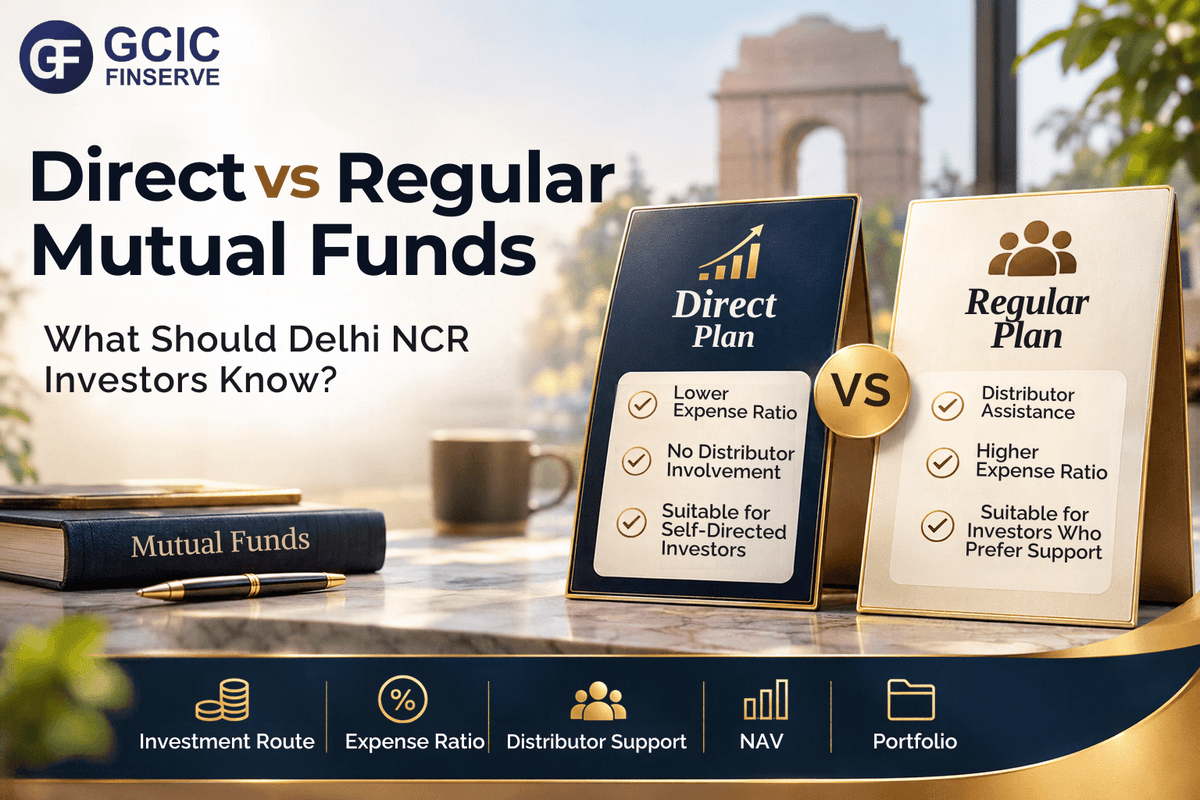
Direct vs Regular Mutual Funds is an important comparison for anyone planning to invest in mutual funds. Both options belong to the same mutual fund scheme, but the way investors access them, the expenses involved, and the support available can differ.
Many investors in Delhi NCR come across these terms while researching mutual fund investments. Understanding the differences can help you make an informed decision based on your investment knowledge, preferences, and requirements.
What Are Direct Mutual Fund Plans?
A Direct Plan allows an investor to invest in a mutual fund scheme without involving a mutual fund distributor.
Investors can access Direct Plans through the respective Asset Management Company's (AMC) official channels and other permitted platforms.
Since there is no distributor commission included in the Direct Plan's expense structure, its expense ratio is generally lower than that of the corresponding Regular Plan of the same scheme.
Direct Plans may be suitable for investors who are comfortable researching mutual fund schemes, understanding scheme documents, comparing relevant information, completing transactions, and monitoring their investments independently.
What Are Regular Mutual Fund Plans?
A Regular Plan is accessed through a mutual fund distributor. The distributor facilitates investment in the scheme and may provide assistance with investment-related processes, documentation, and investor communication.
The expense ratio of a regular plan generally includes distribution-related expenses. As a result, its expense ratio is usually higher than that of the corresponding Direct Plan.
In a Regular Plan, the distributor receives commission from the Asset Management Company (AMC), subject to applicable regulatory requirements and the scheme's expense structure. These distribution-related expenses are reflected in the Regular Plan's expense ratio.
Investors should understand both the costs involved and the services offered before choosing this route.
Direct vs Regular Mutual Funds: Key Differences
| Feature | Direct Plan | Regular Plan |
|---|---|---|
| Investment route | Directly through AMC or permitted platforms | Through a mutual fund distributor |
| Expense ratio | Generally lower | Generally higher |
| Distributor involvement | No distributor involved | Distributor involved |
| Distributor commission | No distributor commission | Distribution-related commission is included in the expense structure |
| Investor responsibility | More independent research and execution | Distributor may assist with investment-related processes |
| Fund manager | Same as corresponding Regular Plan | Same as corresponding Direct Plan |
| Portfolio | Same underlying scheme portfolio | Same underlying scheme portfolio |
| NAV | Separate NAV | Separate NAV |
Both plans of the same mutual fund scheme have the same fund manager and common underlying portfolio. However, their expense ratios and Net Asset Values (NAVs) are different.
Because the Direct Plan generally has a lower expense ratio, its NAV is generally higher than the corresponding Regular Plan's NAV, all else being equal.
Which Option Should Delhi NCR Investors Choose?
There is no single option that is suitable for every investor.
A Direct Plan may be considered by investors who have sufficient knowledge of mutual fund products, understand scheme-related risks, and are comfortable researching, selecting, and managing investments independently.
A Regular Plan may be considered by investors who prefer to invest through a mutual fund distributor and value the process assistance and investor service support offered.
The choice should depend on an investor's knowledge, preferences, and understanding of costs and requirements.
Distributor involvement does not guarantee better returns, eliminate investment risk, or automatically mean that every service is included. Investors should understand the services being provided and the applicable costs before making a decision.
Understand Costs Before Investing
The expense ratio is an important factor because it represents the recurring expenses charged to a mutual fund scheme.
A lower expense ratio can reduce the cost of holding a scheme. However, cost should not be the only selection criterion.
Investors should also consider:
- The investment objective of the scheme.
- The underlying portfolio and investment strategy.
- The scheme's Riskometer and associated risks.
- The investment horizon and financial requirements.
- The expense ratio and other applicable costs.
- The services available through the chosen investment route.
Do not select a mutual fund scheme only because its Direct Plan or Regular Plan has shown particular recent returns. Past performance is not indicative of future returns.
How Can You Compare Mutual Fund Options?
Investors in South Delhi, Greater Kailash, Gurgaon, Noida, and other parts of Delhi NCR can explore mutual fund information and scheme-related resources before making investment decisions.
GCIC Finserve provides access to mutual fund categories and investment-related resources through its website.
You can explore:
- GCIC Finserve Mutual Funds: Explore mutual fund categories and related information.
- Scheme Performance Tool: Review scheme performance and related metrics. Historical performance does not guarantee future results.
For independent investor education, refer to:
- AMFI – Association of Mutual Funds in India: Learn about mutual funds and investment-related concepts.
- SEBI Investor Education: Access investor awareness and educational resources.
Make an Informed Mutual Fund Decision
Understanding the difference between direct and regular mutual funds is an important part of mutual fund education. Both plans provide access to the same underlying scheme portfolio, but their expense structures and investment routes differ.
Before choosing a plan, understand the costs, services, responsibilities, and risks involved. Investors can explore GCIC Finserve's mutual fund resources and refer to official AMFI and SEBI investor education materials to learn more.
Frequently Asked Questions
Disclaimer: Mutual Fund investments are subject to market risks. Please read all scheme-related documents carefully before investing. The information in this article is provided solely for general educational and informational purposes. It does not constitute investment advice, a recommendation, or an offer or solicitation to buy or sell any mutual fund scheme or other financial product. Investors should assess their financial goals, risk tolerance, investment horizon, and product-related risks before making any decision. Past performance is not indicative of future returns. Returns are not guaranteed, and the value of investments may go up or down. For tax-related matters, tax treatment depends on applicable laws and the investor's individual circumstances; consult a qualified tax professional where required. GCIC Finserve Limited is an AMFI-registered Mutual Fund Distributor (ARN-272705), not a SEBI-registered Investment Adviser.
Related Insights & Market Perspectives
Mutual Fund Risk Profiler: Understand Your Investor Personality
Discover your investor personality with a Mutual Fund Risk Profiler. Assess risk tolerance, investment horizon and financial capacity to understand asset allocation.
Scheme Performance Tracker: How to Compare Mutual Fund Performance
Learn how to use a Scheme Performance Tracker to compare mutual fund scheme performance, review historical returns and understand key factors before investing.
First-Time SIP Investor in South Delhi? Here's How to Get Started
Planning your First SIP Investment in South Delhi? Learn how SIPs work, choose an investment amount, and understand the steps to start investing.