

Scheme Performance Tracker: How to Compare Mutual Fund Performance
When exploring mutual funds, investors often look at past returns to understand how a scheme has performed. However, comparing mutual fund schemes requires more than simply checking which one delivered the highest return.
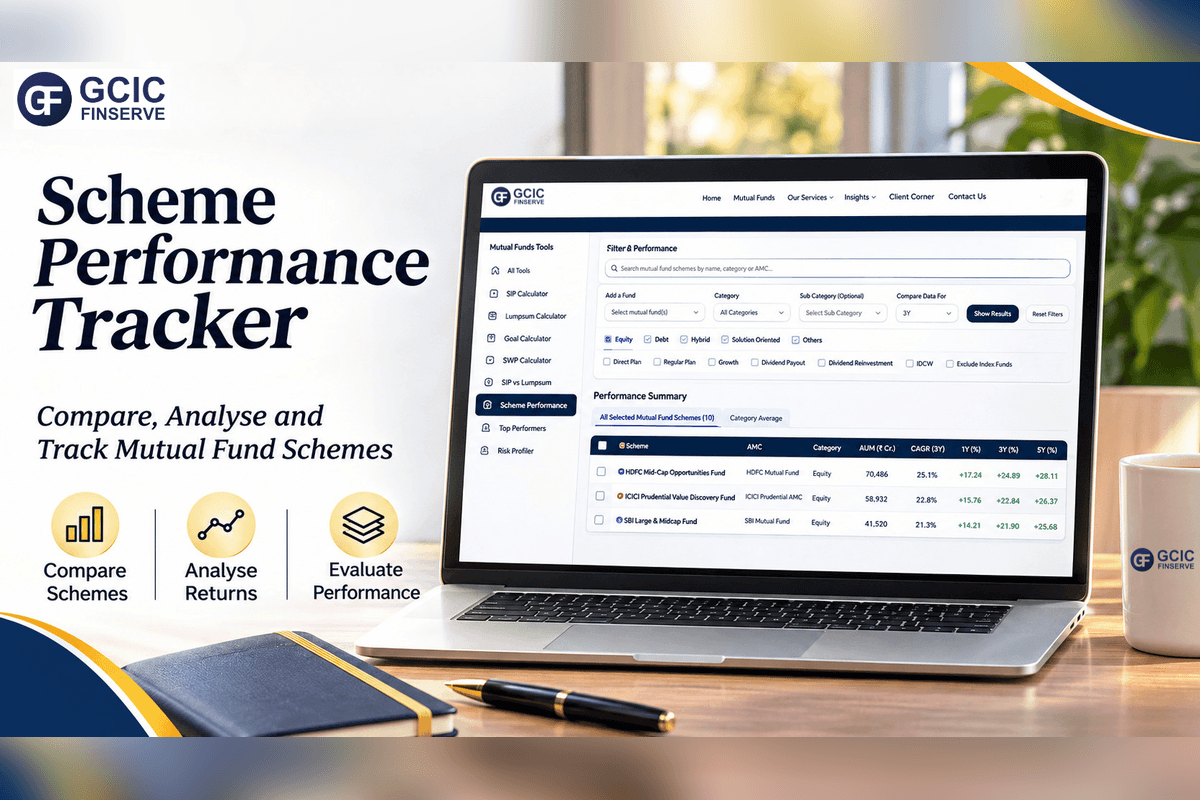
A Scheme Performance Tracker can help investors compare the historical performance of mutual fund schemes and understand how their returns have changed over different periods. It can be a useful research tool when exploring mutual fund categories and reviewing available investment information.
Whether you are a first-time investor or reviewing an existing portfolio, understanding scheme performance can help you ask better questions before making an investment decision.
For investors in South Delhi, Greater Kailash and across Delhi NCR, GCIC Finserve provides a Scheme Performance Tracker to explore mutual fund scheme performance.
What Is a Scheme Performance Tracker?
A Scheme Performance Tracker is a tool that helps investors review and compare the historical performance of mutual fund schemes.
Instead of looking at one scheme in isolation, investors can use performance information to understand how different schemes have performed over selected periods.
It can help investors:
- Compare the historical returns of mutual fund schemes.
- Understand performance trends over different periods.
- Explore differences between schemes.
- Review performance information as part of mutual fund research.
- Make more informed comparisons before investing.
However, historical performance is only one part of mutual fund research. It should not be treated as a prediction of future returns.
Why Is Comparing Mutual Fund Performance Important?
Different mutual fund schemes may follow different investment strategies, hold different securities and carry different levels of risk.
Comparing performance can help investors understand these differences.
1. Understand Historical Returns
Historical returns show how a mutual fund scheme performed during a particular period. Reviewing different periods can provide a broader picture than looking at only its latest performance.
2. Compare Similar Mutual Fund Schemes
Comparisons are generally more meaningful when schemes belong to the same category and have similar investment objectives.
For example, comparing two large-cap equity funds may provide more relevant information than comparing a large-cap equity fund with a short-duration debt fund.
3. Identify Performance Trends
Reviewing performance over multiple periods can help investors understand whether a scheme's performance has been consistent or has varied significantly.
A single strong period should not be the only reason to consider a scheme.
4. Support Better Investment Research
Performance information can be considered alongside the scheme's investment objective, portfolio, benchmark, expense ratio and Riskometer.
This creates a more complete picture than relying on returns alone.
How to Compare Mutual Fund Scheme Performance
Before comparing schemes, consider the following factors:
1. Compare Schemes Within the Same Category
Mutual funds have different objectives and investment strategies. Equity, debt, and hybrid funds may behave differently because of their underlying investments.
Where possible, compare schemes within the same category rather than ranking unrelated schemes together.
2. Review Multiple Time Periods
A scheme may perform differently over short, medium, and longer periods.
Reviewing multiple time periods can help reduce the risk of forming an opinion based on one unusually strong or weak period.
3. Compare Performance With the Relevant Benchmark
A mutual fund scheme generally has a benchmark against which its performance can be evaluated.
Comparing a scheme with its relevant benchmark can provide additional context about its historical performance.
4. Understand the Scheme's Risk
Higher historical returns do not automatically mean a scheme is more suitable.
Review the scheme's Riskometer, portfolio composition, investment strategy, and the risks associated with its underlying securities.
5. Check Expense Ratios and Other Costs
The expense ratio represents recurring expenses charged to a mutual fund scheme.
Investors should understand the scheme's expense ratio and other applicable costs rather than comparing returns in isolation.
How to Use the GCIC Finserve Scheme Performance Tracker
Investors can explore GCIC Finserve's Scheme Performance Tracker to compare mutual fund scheme performance.
Follow these general steps:
- 1Visit the tool: Open the GCIC Finserve Scheme Performance Tracker.
- 2Explore the available schemes: Review the mutual fund schemes displayed in the tool.
- 3Compare performance information: Examine the historical performance data available for the schemes.
- 4Review the differences: Consider the scheme category, investment objective and relevant time periods.
- 5Research further: Read the scheme documents, benchmark details, portfolio disclosures and Riskometer before making an investment decision.
Use the tool here:GCIC Finserve Scheme Performance Tracker
The information displayed by the tool should be considered along with the latest scheme-related documents and disclosures.
Common Mistakes to Avoid When Comparing Mutual Funds
Investors should avoid making decisions based only on a scheme's recent performance.
Some common mistakes include:
- Selecting a scheme only because it has delivered high recent returns.
- Comparing funds from unrelated categories.
- Ignoring the scheme's investment objective and risk level.
- Overlooking the benchmark and portfolio composition.
- Ignoring expense ratios and applicable costs.
- Assuming past performance will continue in the future.
A mutual fund scheme should be evaluated on several factors, not just its return history.
Why Performance Comparison Should Be Part of Portfolio Review
Reviewing a mutual fund portfolio involves more than checking whether its value has increased or decreased.
Investors can periodically review their financial goals, asset allocation, scheme performance, portfolio holdings and risk exposure.
Performance comparison can be one part of this process. It may help investors identify questions that need further research, but it does not automatically mean that an underperforming scheme should be sold or a high-performing scheme should be purchased.
Any portfolio changes should take account of financial goals, investment horizon, risk tolerance, applicable taxes, and exit loads.
Explore Mutual Fund Resources With GCIC Finserve
GCIC Finserve Limited provides mutual fund distribution services and investor resources to help individuals understand mutual fund categories and investment-related information.
Investors in Greater Kailash, South Delhi and other parts of Delhi NCR can explore the available resources:
- Explore GCIC Finserve Mutual Fund Services
- Use the Scheme Performance Tracker
- Explore the SIP Calculator
- Contact GCIC Finserve
For additional investor education, visit AMFI Investor Corner and SEBI Investor.
Make More Informed Mutual Fund Comparisons
Understanding mutual fund performance is an important part of investment research. A Scheme Performance Tracker can make it easier to review historical returns and compare available schemes.
However, investors should look beyond return figures and consider the scheme's category, risk, benchmark, portfolio, and investment objective before making decisions.
Explore the GCIC Finserve Scheme Performance Tracker to understand mutual fund performance and support a more informed research process.
Frequently Asked Questions
Disclaimer: Mutual fund investments are subject to market risks. Please read all scheme-related documents carefully before investing. The information in this article is provided solely for general educational and informational purposes. It does not constitute investment advice, a recommendation, or an offer or solicitation to buy or sell any mutual fund scheme or other financial product. Investors should assess their financial goals, risk tolerance, investment horizon, and product-related risks before making any decision. Past performance is not indicative of future returns. Returns are not guaranteed, and the value of investments may go up or down. GCIC Finserve Limited is an AMFI-registered Mutual Fund Distributor (ARN-272705), not a SEBI-registered Investment Adviser.
Related Insights & Market Perspectives
SIP vs Lump Sum Investment: Which Is Better for Investors in South Delhi?
Understand SIP vs Lump Sum Investment, their benefits, risks and differences. Explore which approach may suit your financial goals in Delhi NCR
Diwali 2026: Smart Investment Habits to Build a Brighter Financial Future
Explore Diwali investment tips for 2026. Discover smart ways to save, invest regularly and build better financial habits for your long-term goals.
Zomato Stock Analysis: When Growth Stories Meet Valuation Reality
Strategic market intelligence covering asset allocation, economic indicators, and wealth structuring principles.