
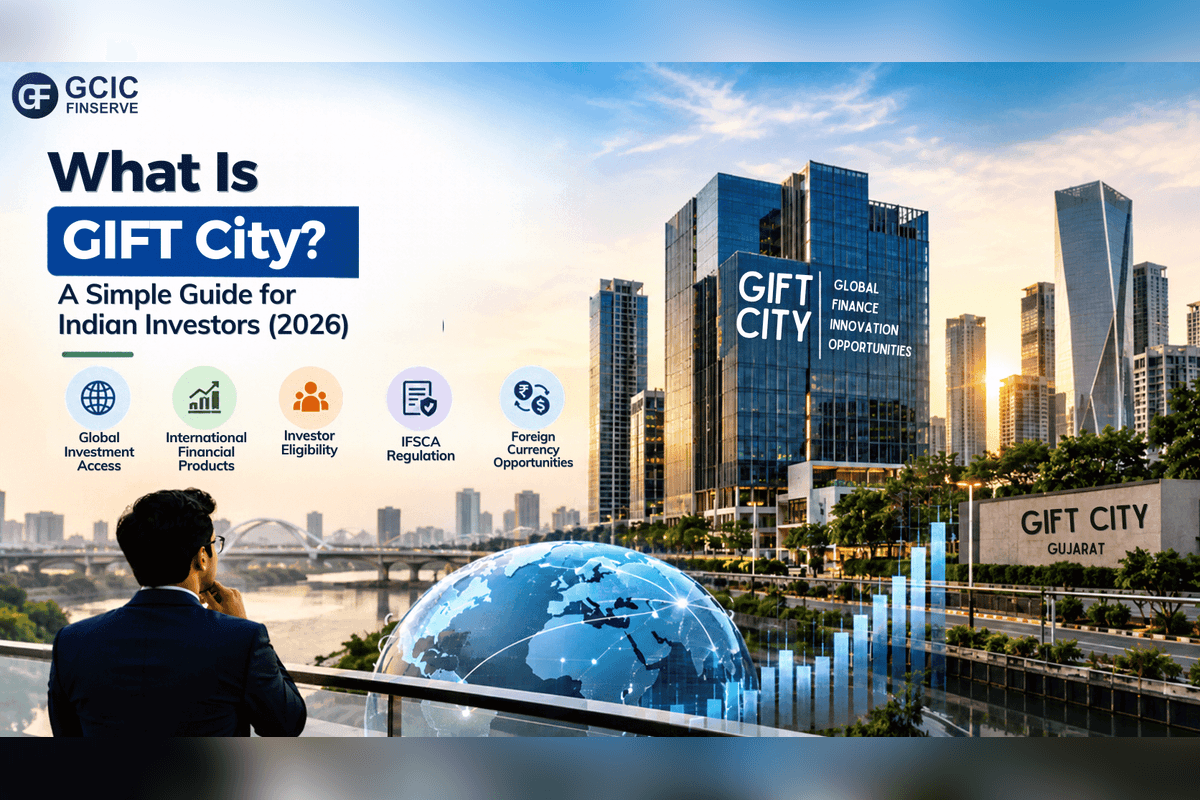
What Is GIFT City? A Simple Guide for Indian Investors (2026)
What is GIFT City, and why is it becoming an important part of India's financial ecosystem?
As Indian investors become more familiar with global markets, international diversification, and foreign-currency investments, GIFT City is attracting increasing attention.
Located in Gujarat, GIFT City is a financial and business district designed to support domestic and international financial activities. Its International Financial Services Centre (GIFT IFSC) provides a specialised regulatory environment for eligible financial institutions and investors.
But how does it actually work? Can Indian residents participate? What types of investments are available, and what risks should investors understand?
This guide explains GIFT City in simple terms, including its purpose, regulatory framework, investment opportunities, eligibility requirements, and important considerations in 2026.
What Is GIFT City?
GIFT City stands for Gujarat International Finance Tec-City.
It is a planned business and financial district located near Gandhinagar in Gujarat, India.
The development aims to create an integrated ecosystem for financial institutions, businesses, technology companies, and international financial services.
An important feature of GIFT City is that it includes India's first International Financial Services Centre, commonly known as GIFT IFSC.
GIFT City comprises different operating areas, including a Domestic Tariff Area (DTA) and a Special Economic Zone (SEZ), within which the IFSC operates.
These areas have different regulatory and operational characteristics.
Therefore, GIFT City and GIFT IFSC should not be treated as identical terms.
In simple words: GIFT City is the broader financial and business district, while GIFT IFSC is the specialised international financial services jurisdiction operating within it.
What Is GIFT IFSC?
IFSC stands for International Financial Services Centre.
An IFSC is a jurisdiction designed to facilitate permitted international financial activities, including cross-border financial services and transactions.
India's first IFSC operates within GIFT City.
It provides a framework through which eligible financial institutions can undertake specified international financial activities from India.
The ecosystem includes activities such as:
- International banking
- Fund management
- Capital market services
- Insurance and reinsurance
- Financial technology
- Aircraft and ship leasing
- Other permitted international financial services
For investors, GIFT IFSC may provide access to certain international financial products and structures through appropriately authorised entities.
However, individual product availability depends on the regulatory framework, investor eligibility, and the terms of the particular product.
Not every investor can access every product offered within GIFT IFSC.
Why Was GIFT City Developed?
International financial activities often require specialised infrastructure, regulatory arrangements, and financial institutions capable of supporting cross-border transactions.
GIFT IFSC was developed to strengthen India's participation in the international financial services ecosystem.
It aims to facilitate financial activities that may otherwise be undertaken through international financial centers outside India.
Its broader objectives include:
Supporting International Financial Services
GIFT IFSC provides a specialised environment for eligible banking, investment, and other financial activities.
Connecting India With Global Markets
The IFSC ecosystem supports permitted international financial transactions and market participation.
Developing Financial Infrastructure
GIFT City brings together financial institutions, technology infrastructure, service providers and supporting businesses.
Supporting Financial Innovation
The ecosystem also facilitates certain financial technology activities and specialised financial services under applicable regulatory arrangements.
These objectives relate to the development of India's international financial services infrastructure. They do not imply that investments available through GIFT IFSC are free from market or financial risks.
How Does GIFT City Work?
To understand how GIFT City works from an investment perspective, it helps to distinguish between the financial ecosystem, authorised institutions and individual products.
Consider the following simplified process.
Step 1: The GIFT IFSC Regulatory Framework
GIFT IFSC operates under a specialised regulatory framework for permitted international financial activities.
Different financial services are governed by applicable regulations and authorisation requirements.
Step 2: Authorised Financial Institutions
Eligible banks, fund management entities and other regulated service providers can operate within GIFT IFSC.
Their activities depend on the permissions and registrations applicable to them.
Step 3: Financial Products and Services
These institutions may offer permitted investment products and financial services.
Examples can include certain investment funds, securities, and foreign-currency financial arrangements.
Each product has its own objectives, risk characteristics, costs, eligibility conditions, and investment terms.
Step 4: Investor Participation
An eligible investor may evaluate a particular product and complete the applicable onboarding requirements.
These can include identity verification, KYC documentation, eligibility checks, funding requirements, and other regulatory procedures.
Important: Investing through GIFT City does not mean investing directly in GIFT City itself. Investors participate in specific products or financial arrangements offered by eligible institutions operating within the ecosystem.
Who Regulates GIFT City?
Financial activities within GIFT IFSC are regulated by the International Financial Services Centres Authority (IFSCA).
IFSCA was established under the International Financial Services Centres Authority Act, 2019, and became operational as the unified regulator in April 2020.
Its responsibilities include developing and regulating financial products, financial services and financial institutions within India's IFSC framework.
The Authority's role covers permitted activities across areas such as banking, capital markets, fund management, and insurance.
This specialised framework distinguishes GIFT IFSC from India's domestic financial markets.
However, regulation should not be confused with an investment guarantee.
An IFSCA-regulated financial product may still involve market risk, liquidity risk, credit risk and other uncertainties.
Investors should confirm the regulatory status of the relevant institution and examine the applicable product documents before participating.
For official information, visitIFSCA.
What Investment Opportunities Are Available Through GIFT City?
One of the reasons investors explore GIFT City is the range of international financial products and structures that may be available within its ecosystem.
These opportunities vary by product, institution, and investor category.
A. International Equity-Oriented Funds
Certain investment funds operating through GIFT IFSC may offer exposure to international equity markets.
Such funds may invest according to defined geographic, sectoral or broader investment strategies.
They can expose investors to international market movements, equity volatility and currency fluctuations.
The availability of a particular fund does not automatically mean it is suitable for every investor.
B. Fixed-Income Investment Products
Certain GIFT IFSC products may provide exposure to debt securities and fixed-income markets.
Potential underlying instruments can include bonds and other eligible debt securities.
The risks depend on the issuer, investment structure, currency, maturity and market conditions.
Fixed-income investments are not necessarily risk-free.
They can involve credit risk, interest-rate risk, liquidity risk, and currency risk.
C. Alternative Investment Strategies
The GIFT IFSC fund management framework also accommodates certain specialised investment strategies.
These may involve alternative assets, private-market opportunities, or other permitted approaches.
Such products can have additional complexity, minimum investment requirements, liquidity restrictions, and specific eligibility conditions.
They should not be interpreted as universally available retail investment options.
D. Foreign-Currency Financial Products
Certain products and financial services within GIFT IFSC operate in foreign currencies, including the US dollar.
Foreign-currency exposure can affect an investment's value when measured in Indian rupees.
For example, changes in the USD-INR exchange rate may influence the rupee value of a dollar-denominated investment.
Currency movements can increase or decrease the eventual rupee value of an investment.
Key takeaway: GIFT City creates a framework for accessing various international financial activities, but the features, risks, and availability of every product must be evaluated individually.
Who Can Invest Through GIFT City?
A common question is whether GIFT City investment opportunities are available only to wealthy investors or whether other individuals can participate.
The answer depends on the specific product and applicable regulations.
Different investor categories may have different access conditions.
Resident Indian Investors
Resident individuals may be able to access eligible financial products and services in GIFT IFSC, subject to applicable rules.
The Reserve Bank of India's Liberalised Remittance Scheme (LRS) provides a regulatory route for certain permitted foreign-exchange remittances by resident individuals.
Under RBI's July 2024 clarification, remittances to IFSCs can be facilitated for eligible financial products and services, subject to LRS conditions and other applicable requirements.
However, this does not mean that all GIFT IFSC products are automatically accessible to every resident Indian.
Product-specific restrictions, funding conditions, and other legal requirements still apply.
Non-Resident Indians (NRIs)
NRIs may be eligible to participate in certain GIFT IFSC products.
Their eligibility depends on the investment product, residency requirements, applicable regulations and documentation.
Overseas Citizens of India (OCIs)
OCI investors may also have access to certain eligible products, subject to the relevant conditions.
High-Net-Worth Investors and Family Offices
Some specialised investment products may be intended for investors who meet particular eligibility or minimum investment requirements.
Such products may involve greater complexity or different risk and liquidity characteristics.
Businesses and Institutions
Eligible corporate entities, institutional investors and other organisations may use specified financial products and services within GIFT IFSC.
Their participation depends on applicable regulations and authorisation requirements.
Important: Investor residency, financial status, product eligibility, funding route, and applicable laws must be checked before assuming that a particular investment is available.
What Are the Potential Benefits of GIFT City?
GIFT IFSC has several features that may make its ecosystem relevant to eligible investors.
Access to International Financial Markets
Certain financial products operating through GIFT IFSC provide exposure to international markets and financial instruments.
This may allow eligible investors to explore opportunities beyond domestic-only products.
Broader Investment Structures
The specialised framework supports different types of financial products and investment strategies.
Some may have characteristics that differ from commonly available domestic investment products.
Foreign-Currency Exposure
Certain products are denominated in foreign currencies.
This may be relevant to investors assessing international currency exposure, although exchange-rate movements can create additional risks.
Specialised Regulatory Environment
IFSCA provides a unified regulatory framework for permitted financial services within the IFSC.
The regulatory environment may differ from the framework applicable to similar products operating in domestic Indian markets.
International Financial Infrastructure
GIFT IFSC brings together financial institutions, service providers and infrastructure supporting cross-border activities.
However, these features should be evaluated as characteristics of the ecosystem rather than promises of superior investment performance.
What Risks Should Investors Understand Before Investing?
Although GIFT IFSC provides access to a range of financial opportunities, investments available through the ecosystem can involve several risks.
1. Market Risk
The value of equity, debt, and other market-linked investments can rise or fall due to market conditions.
2. Currency Risk
Foreign-exchange movements can affect the value of investments denominated in currencies other than the investor's reference currency.
3. Liquidity Risk
Some products may have restrictions on withdrawals, transfers, or redemption.
Investors should understand the applicable lock-in periods, exit provisions, and liquidity arrangements.
4. Credit Risk
Debt-oriented products can involve the risk that an issuer may fail to meet its financial obligations.
5. Strategy Risk
Certain specialised investment strategies may be complex or involve concentrated exposure, leverage, or other risks, where permitted.
6. Tax and Regulatory Risk
The tax treatment of a particular investment can depend on several factors, including the investor's residential status, product structure and applicable laws.
Regulatory changes may also influence product operations or eligibility conditions.
7. Costs and Charges
Investment returns can be affected by management fees, transaction costs, currency-conversion expenses, and other applicable charges.
Investor takeaway: International access and regulatory oversight do not eliminate investment risk. Understanding the complete product structure is important before making any investment decision.
Is GIFT City Investment Tax-Free?
No. It would be incorrect to assume that every investment made through GIFT City is automatically tax-free.
Certain eligible entities, transactions, or financial structures within GIFT IFSC may qualify for specific tax provisions or incentives under applicable laws.
However, the treatment of an individual investor's returns can vary depending on:
- The investor's tax residency
- The type of investment product
- The legal structure of the fund or financial arrangement
- The nature of the income or capital gain
- The applicable Indian and foreign tax laws
- Relevant conditions, exemptions, and reporting obligations
A product that qualifies for particular benefits at the entity level may not necessarily provide identical benefits to every investor.
Investors should therefore avoid making investment decisions based solely on general statements about GIFT City tax advantages.
A qualified tax professional can help explain the implications of a specific transaction under the rules applicable at that time.
GIFT City vs Traditional Indian Investment Markets
GIFT IFSC and domestic Indian financial markets operate under different regulatory frameworks.
Both can support investment activity, but their characteristics are not identical.
| Feature | GIFT IFSC | Domestic Indian Markets |
|---|---|---|
| Primary regulatory framework | IFSCA for IFSC activities | Relevant domestic regulators |
| Market orientation | International financial services | Primarily domestic financial services |
| Currency | Many products use foreign currencies | Many domestic products use INR |
| Investment products | Permitted IFSC-specific structures and products | Domestic market products |
| Eligibility | Product-specific and regulatory conditions | Product-specific domestic requirements |
| Taxation | Depends on structure, residency, and applicable law. | Depends on product and applicable law |
| Investment risk | Depends on underlying product | Depends on underlying product |
Neither framework is automatically better for every investor.
The relevance of a particular financial product depends on its characteristics, objectives, costs, risks and the investor's eligibility.
How Can Investors Explore GIFT City Opportunities?
Investors who want to understand GIFT IFSC products may begin with a structured information-gathering process.
Step 1: Understand the Financial Product
Identify the type of product, its investment objective, underlying assets and operating structure.
Step 2: Verify the Institution
Check whether the relevant financial institution is appropriately authorised for the activity being offered.
Step 3: Confirm Eligibility
Review residency conditions, investor classification, minimum investment requirements and other applicable restrictions.
Step 4: Understand Funding Requirements
Determine the permitted investment and remittance routes, including relevant foreign-exchange regulations where applicable.
Step 5: Review Risks, Fees and Liquidity
Examine market risks, currency exposure, costs, redemption provisions and available disclosures.
Step 6: Consider Tax Implications
Understand the potential tax and reporting obligations associated with the transaction.
These steps are general educational considerations. They do not represent a recommendation to invest in any particular product.
GCIC Finserve and GIFT City
GCIC Finserve Limited AMFI-registered Mutual Fund Distributor | ARN-272705
At GCIC Finserve, we believe understanding the structure, eligibility, and risks of an investment is important before evaluating its suitability.
OurGIFT City service page provides an overview of international investment opportunities and financial products accessible through applicable distribution arrangements.
Investors can explore information relating to:
- The GIFT IFSC ecosystem
- Financial product characteristics
- Relevant eligibility conditions
- Investment documentation and requirements
- Associated market, currency, and liquidity risks
The availability of individual products and the scope of any distribution assistance depend on applicable regulatory permissions and arrangements.
Explore GIFT City With GCIC Finserve
Interested in understanding GIFT IFSC and the types of investment products available through its ecosystem?
Explore GCIC Finserve's GIFT City Services to learn more about the financial products, relevant requirements, and available distribution-related assistance.
Final Thoughts
So, what is GIFT City, and why does it matter for Indian investors?
GIFT City represents an important development in India's financial infrastructure, bringing together international financial institutions, specialized services, and a dedicated regulatory framework.
Its International Financial Services Centre supports a range of permitted cross-border financial activities and may provide eligible investors with access to different international investment products and structures.
However, understanding GIFT IFSC requires looking beyond the potential opportunities.
Investor eligibility, currency exposure, product-specific risks, applicable regulations, costs and taxation all deserve careful consideration.
GIFT City provides a gateway to international financial services, but informed participation begins with understanding the products and their risks.
For more information, visitGCIC Finserve's GIFT City page or refer to the officialIFSCA website.
---
Frequently Asked Questions
Disclaimer: This article is for general educational and informational purposes only and does not constitute investment, financial, tax, or legal advice. GCIC Finserve Limited is an AMFI-registered mutual fund distributor (ARN-272705). Product availability, distribution arrangements, and investor eligibility are subject to applicable regulations and approvals. Investments involve market, currency, and other risks. Past performance does not guarantee future returns. Please review relevant product documents and consult appropriately qualified professionals before making investment decisions.
Related Insights & Market Perspectives
How to Divide Your Wealth: 6 Smart Steps for Equity, Debt, Gold, and Real Estate
How to divide your wealth across equity, debt, gold, and real estate? Delhi NCR families learn 6 smart steps based on goals, risk and liquidity.
What Happens to Your Investments After You Die? 7 Key Steps Every Delhi NCR Family Should Know
What happens to your investments after you die is a question many people avoid. We spend years deciding where to invest but very little time planning what happens to that money when we're gone. You may have mutual funds across several folios, shares in a demat account, fixed deposits with different banks, insurance policies, bonds,.
What Are Mutual Funds? A Beginner’s Guide to Smart Investing
What Are Mutual Funds? If you’re new to investing, you may have heard this question many times but still be unsure how mutual funds actually work. Mutual funds are a popular investment option because they allow investors to participate in a diversified portfolio managed by professionals. This beginner-friendly guide explains mutual fund basics, different types of.