

EMI Planner: How to Calculate Your Monthly Loan Payments Before Borrowing
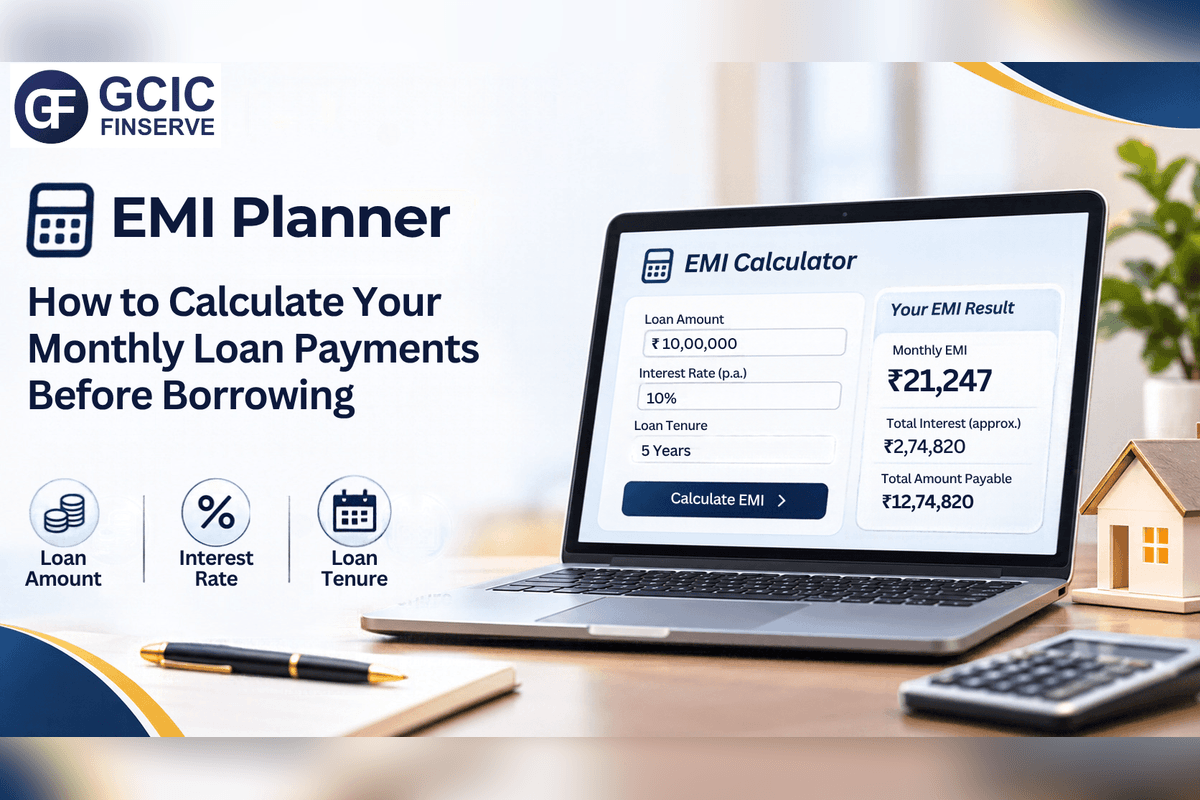
Taking a loan is a major financial commitment. Whether you are planning to purchase a home, buy a car, fund personal expenses, or meet another financial requirement, understanding your monthly repayment obligation is important before borrowing.
One of the first questions borrowers should ask is: How much EMI will I have to pay every month?
An EMI Planner can help you estimate your monthly loan installment, understand the impact of interest rates, and compare different loan repayment periods.
In this guide, we explain how EMI planning works, what affects your monthly payments, and how you can use the GCIC Finserve EMI Calculator to plan your loan repayments.
1. What Is an EMI Planner?
An EMI Planner is a financial tool that helps you estimate the monthly installment payable towards a loan.
EMI stands for Equated Monthly Instalment. It is the amount a borrower generally pays to the lender every month until the loan is repaid, subject to the loan agreement.
An EMI usually includes two components:
- Principal: The original amount borrowed from the lender.
- Interest: The cost charged by the lender for providing the loan.
An EMI Planner helps you understand your estimated monthly repayment based on the loan amount, interest rate, and repayment tenure.
Try the GCIC Finserve EMI Calculator:
https://gcicfinserve.com/tools/emi-calculator
2. Why Should You Calculate Your EMI Before Taking a Loan?
Before applying for a loan, it is important to understand whether the monthly repayment fits comfortably within your budget.
Using an EMI Calculator can help you:
Plan your monthly budget: Estimate how much of your monthly income may go towards loan repayments.
Compare loan tenures: Understand how changing the repayment period affects your monthly EMI.
Understand interest costs: Estimate the total interest payable over the loan period.
Compare borrowing options: Explore different loan amounts and interest rate assumptions.
Avoid excessive borrowing: Assess your repayment commitment before deciding how much to borrow.
An EMI estimate can support better budgeting, but the final loan terms depend on the lender's approval and loan agreement.
3. How Is EMI Calculated?
EMI is generally calculated using the loan amount, monthly interest rate and repayment tenure.
The standard EMI formula is:
EMI = [P × R × (1 + R)ⁿ] / [(1 + R)ⁿ − 1]
Where:
- P: Principal loan amount
- R: Monthly interest rate
- N: Total number of monthly installments
For example, if the annual interest rate is 10%, the monthly interest rate is calculated as 10% divided by 12, or approximately 0.8333%.
The EMI formula uses this monthly rate and the total number of monthly installments to estimate your repayment amount.
4. Example: Calculate Your Monthly Loan EMI
Let's understand EMI planning with a simple example.
Suppose you are considering a loan with the following details:
| Loan Details | Amount |
|---|---|
| Loan amount | ₹10,00,000 |
| Annual interest rate | 10% |
| Loan tenure | 5 years |
| Number of monthly installments | 60 |
Based on these assumptions:
| Repayment Details | Estimated Amount |
|---|---|
| Monthly EMI | ₹21,247 |
| Total amount payable | ₹12,74,820 |
| Total interest payable | ₹2,74,820 |
These figures are approximate and assume a fixed interest rate, monthly repayments, and no additional charges.
Your actual EMI may differ depending on the lender's calculation method, applicable interest rate, fees and loan terms.
- 5How Do Loan Amount, Interest Rate and Tenure Affect Your EMI?
Three major factors influence your monthly EMI.
Loan Amount
The loan amount is the principal borrowed from the lender.
Generally, a higher loan amount results in a higher EMI when the interest rate and repayment tenure remain unchanged.
Interest Rate
The interest rate determines the cost of borrowing.
A higher interest rate generally increases both your monthly EMI and the total interest payable over the loan period.
Loan Tenure
Loan tenure refers to the period over which you repay the loan.
A longer tenure generally reduces the monthly EMI but may increase the total interest paid. A shorter tenure generally increases the monthly EMI but can reduce the overall interest cost.
It is important to compare both monthly affordability and total repayment costs before selecting a loan tenure.
6. How to Use the GCIC Finserve EMI Calculator
You can use the GCIC Finserve EMI Calculator to estimate your monthly loan repayments.
Follow these steps:
Step 1: Open the EMI Calculator
Visit the GCIC Finserve EMI Calculator:
https://gcicfinserve.com/tools/emi-calculator
Step 2: Enter the loan amount
Add the amount you are planning to borrow.
Step 3: Enter the interest rate
Provide the applicable or assumed annual interest rate.
Step 4: Select the loan tenure
Enter the repayment period for your loan.
Step 5: Calculate your EMI
Use the calculator to estimate your monthly installment.
Step 6: Review the results
Understand your estimated EMI and repayment amount. Adjust the loan amount, interest rate or tenure to compare different scenarios.
Using different inputs can help you understand how your borrowing decision may affect your monthly budget.
7. Tips for Managing Your Loan Repayments
Good loan planning does not end after calculating your EMI. Managing repayments consistently is equally important.
1. Set a realistic repayment budget
Consider your regular household expenses, savings, and other financial commitments before taking a loan.
2. Compare interest rates
Review loan offers from different lenders and compare their interest rates, charges, and repayment conditions.
3. Choose a suitable tenure
Do not select a longer tenure only because it offers a lower EMI. Consider the total interest payable as well.
4. Maintain an emergency fund
An emergency reserve can help you manage unexpected expenses without immediately disrupting your regular financial commitments.
5. Avoid multiple unnecessary loans
Taking several loans at the same time can increase your monthly repayment burden.
6. Pay EMIs on time
Missed or delayed payments may result in additional charges and can negatively affect your credit history.
7. Review prepayment conditions
If you are considering repaying your loan early, check the lender's prepayment or foreclosure conditions and applicable charges.
8. Common EMI Planning Mistakes to Avoid
Borrowers sometimes focus only on the monthly EMI and overlook the overall cost of borrowing.
Here are some common mistakes to avoid:
- Choosing a loan amount without reviewing monthly affordability.
- Ignoring the total interest payable.
- Selecting a longer tenure without comparing overall costs.
- Not checking processing fees and other applicable charges.
- Assuming that the interest rate will remain unchanged on a floating-rate loan.
- Taking multiple loans without reviewing existing repayment commitments.
- Missing EMI payment dates.
A proper EMI estimate can help you understand your repayment obligations before making a borrowing decision.
Conclusion:
Taking a loan is an important financial commitment, and understanding your repayment capacity before borrowing can help you make more informed decisions.
Before choosing a loan, consider the monthly EMI, interest rate, total repayment amount, and loan tenure. Make sure the repayment fits comfortably within your monthly budget without affecting your essential expenses and savings.
A little financial planning today can help you manage your loan commitments more responsibly in the future.
Use the GCIC Finserve EMI Calculator to estimate your monthly installments, compare different loan scenarios, and understand your potential repayment obligations before borrowing.
Calculate your EMI. Plan your finances. Borrow responsibly.
Calculate Your EMI with GCIC Finserve
Useful Resources
You can explore more financial planning tools and resources from GCIC Finserve:
Frequently Asked Questions
Disclaimer: This article is for educational and informational purposes only. EMI calculations are illustrative estimates based on the loan amount, interest rate, and repayment tenure entered. Actual loan terms, interest rates, charges, and repayment amounts may vary depending on the lender and loan agreement. This article should not be considered financial or credit advice or a recommendation to take any particular loan. Borrowers should carefully review the lender's terms and conditions before making a borrowing decision. GCIC Finserve Limited is an AMFI-registered Mutual Fund Distributor (ARN-272705), not a SEBI-registered Investment Adviser and not a lender.
Related Insights & Market Perspectives
What Is GIFT City? A Simple Guide for Indian Investors (2026)
What is GIFT City and how does GIFT IFSC work? Understand its financial ecosystem, IFSCA regulation and international investment opportunities.
How to Divide Your Wealth: 6 Smart Steps for Equity, Debt, Gold, and Real Estate
How to divide your wealth across equity, debt, gold, and real estate? Delhi NCR families learn 6 smart steps based on goals, risk and liquidity.
What Happens to Your Investments After You Die? 7 Key Steps Every Delhi NCR Family Should Know
What happens to your investments after you die is a question many people avoid. We spend years deciding where to invest but very little time planning what happens to that money when we're gone. You may have mutual funds across several folios, shares in a demat account, fixed deposits with different banks, insurance policies, bonds,.