

Large Cap vs Mid Cap vs Small Cap: Which Fund to Choose?
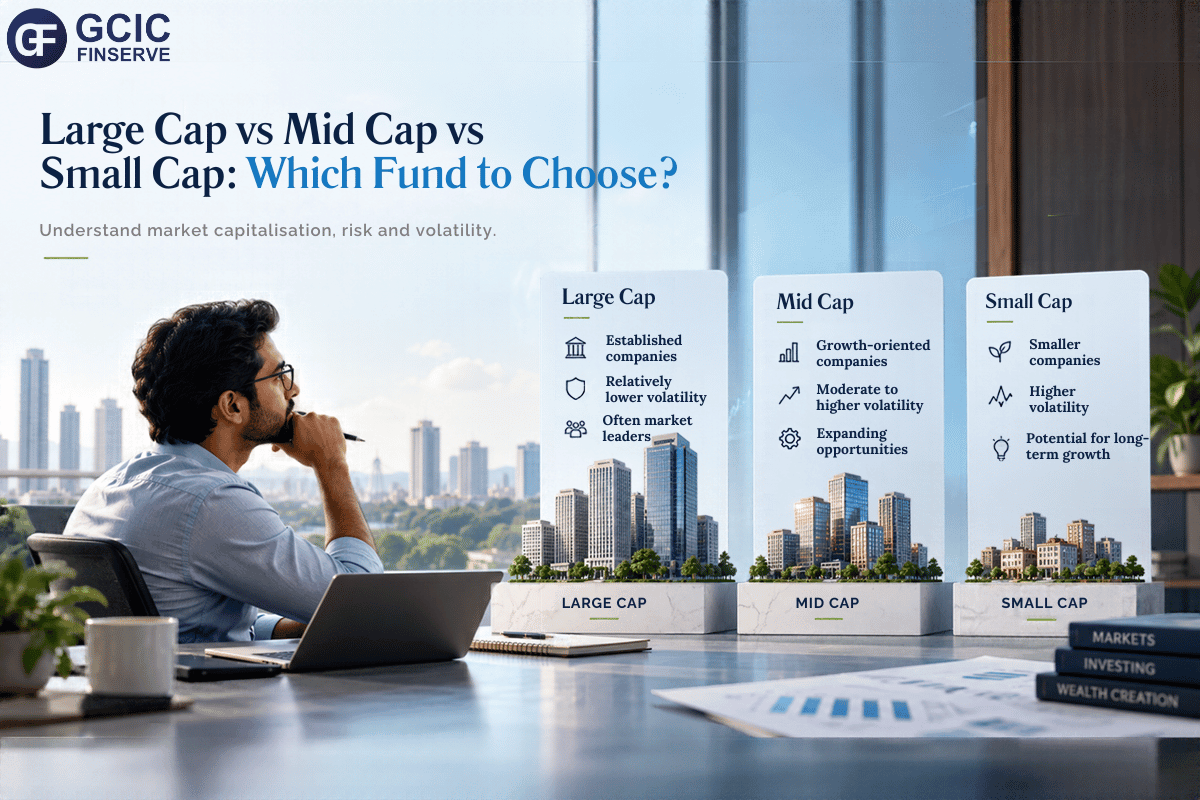
When exploring equity mutual funds, investors often come across three familiar terms: large cap, mid cap and small cap.
These categories may appear similar because they all involve investing in equity markets. However, the types of companies they invest in, their market behavior, and their associated risks can differ significantly.
A large-cap fund generally focuses on India's largest listed companies. A mid-cap fund invests predominantly in companies positioned below the large-cap segment by market capitalisation. A small-cap fund focuses on companies further down the market-capitalisation ranking.
But does that mean large-cap funds are always safer? Do small-cap funds always generate higher returns? And how should investors understand the difference?
The answer depends on more than the size of the companies.
This article explains large cap vs mid cap vs small cap mutual funds, how SEBI classifies them, their differences in volatility and liquidity, and the considerations investors should understand before evaluating these categories.
What Is Market Capitalisation?
Market capitalisation, commonly called market cap, represents the total market value of a listed company's outstanding equity shares.
It is generally calculated using the following formula:
Market Capitalisation = Current Share Price × Total Outstanding Equity Shares
For example, suppose a hypothetical listed company has:
- Share price: ₹500
- Outstanding equity shares: 10 crore
Its market capitalisation would be:
₹500 × 10 crore = ₹5,000 crore
This calculation indicates the company's approximate equity market value at that share price.
However, market capitalisation is not the same as a company's revenue, profits, total assets or financial strength.
A larger market cap does not automatically mean that a company is financially healthier or that its shares cannot decline in value.
How Does SEBI Classify Large-Cap, Mid-Cap and Small-Cap Companies?
In India, the Securities and Exchange Board of India (SEBI) provides standardised market-capitalisation categories for mutual fund investment purposes.
Under the applicable classification framework:
| Category | Market-capitalisation ranking |
|---|---|
| Large cap | 1st to 100th entities |
| Mid cap | 101st to 250th entities |
| Small cap | 251st entity onwards |
The ranking is based on full market capitalisation, rather than a fixed rupee-value threshold.
This distinction is important.
A company does not become a large-cap company simply because its market capitalisation crosses a particular amount, such as ₹10,000 crore or ₹50,000 crore.
Its classification depends on its position in the applicable market-capitalisation ranking.
The Association of Mutual Funds in India (AMFI) publishes the classification list in accordance with SEBI's framework. The list is updated periodically, generally every six months, to reflect changes in market capitalisation.
Consequently, the classification of an individual security can change over time.
For the latest classification, investors can consult the officialAMFI categorisation of stocks.
What Is a Large-Cap Mutual Fund?
A large-cap mutual fund is an equity mutual fund that invests predominantly in large-cap companies.
Under SEBI's February 26, 2026, scheme categorisation framework, a large-cap fund must invest at least 80% of its total assets in equity and equity-related instruments of large-cap companies.
Large-cap companies generally represent established businesses with relatively substantial market capitalisation.
They may operate across sectors such as banking, technology, consumer products, industrial manufacturing, and healthcare.
Characteristics of Large-Cap Funds
Exposure to larger businesses
Large-cap funds primarily invest in companies at the top of the market-capitalisation ranking.
Generally higher trading liquidity
Shares of many large-cap companies tend to be more actively traded than those of smaller companies, although liquidity varies by security and market conditions.
Potentially lower volatility relative to smaller-cap segments
Large-cap stocks may experience less extreme price fluctuations than mid-cap or small-cap stocks during certain market periods.
However, this is a general market tendency, not a guarantee.
Equity-market exposure
Large-cap mutual funds remain subject to market risks, sector-specific developments, company performance, and broader economic conditions.
Can Large-Cap Funds Lose Money?
Yes, Large-cap funds can experience meaningful losses during market corrections, economic downturns, or periods of poor business performance.
Investing in larger companies does not provide capital protection or guaranteed returns.
What Is a Mid-Cap Mutual Fund?
A mid-cap mutual fund is an equity mutual fund that invests predominantly in mid-cap companies.
Under the applicable SEBI categorisation framework, a mid-cap fund must invest at least 65% of its total assets in equity and equity-related instruments of mid-cap companies.
Mid-cap companies occupy the market-capitalisation segment below large-cap entities and above small-cap entities.
Some may be established businesses expanding into new markets or industries. Others may face considerable competitive, operational, or financing challenges.
Characteristics of Mid-Cap Funds
Exposure to medium-sized companies
Mid-cap funds predominantly invest in businesses ranked within the mid-cap classification.
Business expansion opportunities
Some mid-cap companies may have opportunities to expand their operations, increase market share, or develop new products.
These opportunities do not guarantee financial success or stronger investment returns.
Potentially higher volatility
Mid-cap stocks can experience larger price movements than large-cap stocks, particularly during periods of market uncertainty.
Liquidity considerations
Trading liquidity may be lower for certain mid-cap securities than for frequently traded large-cap stocks.
Are Mid-Cap Funds Riskier Than Large-Cap Funds?
Mid-cap funds generally carry greater volatility and liquidity-related risks than large-cap funds.
However, the actual risk of an individual scheme depends on its portfolio, sector exposure, concentration, investment strategy, and prevailing market conditions.
Not every mid-cap fund will be more volatile than every large-cap fund during every period.
What Is a Small-Cap Mutual Fund?
A small-cap mutual fund is an equity mutual fund that invests predominantly in small-cap companies.
Under SEBI's applicable categorisation framework, a small-cap fund must invest at least 65% of its total assets in equity and equity-related instruments of small-cap companies.
Small-cap companies fall below the top 250 entities in the relevant market-capitalisation ranking.
This segment includes businesses across many industries, with different operating histories, balance sheet strengths, and growth prospects.
Characteristics of Small-Cap Funds
Exposure to smaller businesses
Small-cap funds focus primarily on companies below the large-cap and mid-cap segments.
Potential business growth opportunities
Some smaller businesses may expand over time, but others may face limited access to capital, competitive pressures, or operational difficulties.
Higher potential volatility
Small-cap stocks can experience substantial price fluctuations, especially during market stress.
Liquidity and execution risks
Shares of certain smaller companies may be less actively traded, potentially making it harder to buy or sell large positions without affecting market prices.
Do Small-Cap Funds Always Give Higher Returns?
No.
Small-cap funds may outperform other market-cap segments during certain periods and underperform significantly during others.
Their higher risk characteristics do not guarantee higher returns.
Past performance is also not a reliable indicator of future returns.
Large Cap vs Mid Cap vs Small Cap: Key Differences
The following comparison summarises the general characteristics of these mutual fund categories.
| Feature | Large-Cap Fund | Mid-Cap Fund | Small-Cap Fund |
|---|---|---|---|
| Primary company segment | Largest market-cap entities | Middle market-cap segment | Smaller market-cap entities |
| SEBI minimum allocation | 80% in large-cap equity and equity-related instruments | 65% in mid-cap equity and equity-related instruments | 65% in small-cap equity and equity-related instruments |
| Typical volatility | Relatively lower | Often higher | Often higher and potentially more severe |
| Liquidity of underlying stocks | Generally more liquid | Varies | Can be more constrained |
| Business characteristics | Often established enterprises | Mix of established and expanding businesses | Diverse smaller businesses |
| Market risk | Present | Present | Present |
| Guaranteed returns | No | No | No |
These are general characteristics, not fixed risk rankings or return predictions. Actual outcomes vary by scheme, portfolio composition and market conditions.
Why Do Large-Cap, Mid-Cap and Small-Cap Funds Behave Differently?
The differences arise partly from the characteristics of their underlying companies.
Business Size and Financial Resources
Larger businesses may have broader operations, more established access to financing and greater diversification across products or markets.
Smaller businesses may have narrower operations or greater dependence on individual products, customers, or funding sources.
However, company size alone cannot determine financial resilience.
Trading Liquidity
Liquidity refers to how easily an investment can be bought or sold without materially affecting its price.
Large-cap shares often experience substantial trading activity.
Certain mid-cap and small-cap shares may trade less frequently, creating additional challenges during market disruptions.
Market Sentiment
During periods of uncertainty, investors may change their preferences between larger and smaller companies.
This can influence valuations, demand, liquidity, and short-term price movements across market-cap segments.
Valuation Risk
A company's growth prospects and its investment valuation are different concepts.
Even a business with strong operating growth can be a poor investment outcome if its shares were purchased at an excessively high valuation.
Similarly, a lower share price does not automatically indicate that a stock is undervalued.
Does Higher Risk Mean Higher Returns?
Not necessarily, Investment risk and expected return are related concepts, but higher risk does not guarantee higher realised returns.
Mid-cap and small-cap stocks may experience periods of substantial growth. They can also experience prolonged declines, business setbacks, and liquidity difficulties.
Consider a hypothetical example:
An investment of ₹1,00,000 falls by 30%.
Its value becomes:
₹1,00,000 × 70% = ₹70,000
To recover from ₹70,000 to ₹1,00,000, the investment must rise by approximately 42.86%.
This shows why losses can have a significant effect on investment outcomes.
The calculation is purely illustrative and is not based on the performance of any actual mutual fund.
Investors should avoid assuming that greater volatility will automatically lead to greater long-term wealth creation.
Which Fund to Choose: Large Cap, Mid Cap or Small Cap?
There is no universally best mutual fund category.
A more useful question is whether the underlying investment characteristics are consistent with an investor's objectives, risk tolerance, investment horizon, and financial circumstances.
Consider the Investment Horizon
Equity markets can experience substantial fluctuations over short periods.
An investor's expected investment duration is relevant when considering exposure to equity investments.
However, no particular holding period eliminates the possibility of losses.
Understand Risk Tolerance
Risk tolerance includes both the financial ability and the willingness to withstand changes in investment value.
An investor should understand the possibility of temporary or prolonged losses before evaluating a category.
Review the Underlying Scheme
Not all mutual funds within a category have identical portfolios.
Scheme characteristics may differ in areas such as
- Sector and stock concentration
- Portfolio diversification
- Investment strategy
- Expense ratio
- Liquidity profile
- Riskometer disclosure
- Portfolio turnover
The scheme's official documents provide important information about these characteristics.
Consider Existing Investments
An investor may already have exposure to large-, mid- or small-cap companies through other mutual funds or direct equity holdings.
Adding another fund from a similar category does not necessarily improve diversification.
Portfolio overlap and concentration are important considerations.
Understand Liquidity Needs
Money required for near-term financial commitments may not be appropriate for investments exposed to substantial equity-market fluctuations.
The ability to tolerate market declines matters alongside the intended holding period.
Investor takeaway: The choice should not be based solely on which category recently delivered the highest returns.
Is It Better to Invest in All Three Categories?
Investing across different market-cap segments can broaden exposure to companies of different sizes.
However, investing in multiple fund categories does not automatically ensure effective diversification.
Two mutual funds can hold some of the same stocks, sectors or investment themes.
Additionally, an investor does not necessarily need three separate mutual funds to obtain exposure across market-cap segments.
Certain other equity mutual fund categories can invest across company sizes, subject to their applicable investment mandates.
The relevant question is how the overall portfolio is constructed and whether its risks are understood.
What Is the Difference Between Large-Cap, Multi-Cap and Flexi-Cap Funds?
The terms may sound similar, but the investment mandates differ.
Under SEBI's February 2026 scheme categorisation framework:
| Mutual fund category | Broad investment requirement |
|---|---|
| Large-cap fund | Minimum 80% in large-cap equity and equity-related instruments |
| Mid-cap fund | Minimum 65% in mid-cap equity and equity-related instruments |
| Small-cap fund | Minimum 65% in small-cap equity and equity-related instruments |
| Multi-cap fund | Minimum 25% each in large-, mid- and small-cap equity and equity-related instruments |
| Flexi-cap fund | Minimum 65% in equity and equity-related instruments, with flexibility across market-cap segments |
A multi-cap fund has specific minimum exposure requirements across the three market-cap segments.
A flexi-cap fund can adjust its allocation between market-cap segments according to its investment mandate, subject to applicable regulations.
Neither structure guarantees superior performance or effective diversification.
Common Mistakes Investors Should Avoid
Choosing a Category Based Only on Recent Returns
Recent returns may reflect a particular market cycle and do not guarantee future performance.
Assuming Large Cap Means Risk-Free
Large-cap funds remain exposed to equity-market risks and can experience losses.
Believing Small Cap Always Means Higher Growth
A smaller company's potential to expand does not guarantee higher profits, stronger share-price performance or higher mutual fund returns.
Ignoring Portfolio Overlap
Owning several mutual funds does not necessarily mean the underlying investments are sufficiently diversified.
Overlooking the Riskometer
Investors should review the scheme's Riskometer, investment objective and relevant risk disclosures.
Confusing Company Size With Fund Suitability
Market capitalisation is one factor in understanding an equity investment. It does not independently determine whether a mutual fund is appropriate for a particular investor.
GCIC Finserve's Perspective for Delhi NCR Investors
AMFI-registered Mutual Fund Distributor | ARN-272705
For investors across Delhi NCR, understanding market-capitalisation categories is an important part of mutual fund education.
Large-cap, mid-cap and small-cap funds offer exposure to different parts of the equity market, but they also carry different investment and operational risks.
AtGCIC Finserve Limited, our mutual fund distribution services include explaining mutual fund scheme characteristics, assisting investors in understanding mutual fund product suitability in relation to their stated objectives and risk profiles, and supporting mutual fund transactions and related servicing.
Our role is that of an AMFI-registered Mutual Fund Distributor, not a SEBI-registered Investment Adviser.
Learn More About Mutual Fund Categories
Explore mutual fund investment categories and distribution services throughGCIC Finserve.
For official information about mutual fund regulations and market-capitalisation classifications, refer toSEBI andAMFI India.
Final Thoughts
Understanding large cap vs mid cap vs small cap is about more than comparing company sizes.
Large-cap funds predominantly invest in the largest market-cap segment. Mid-cap funds focus on the next segment, while small-cap funds invest primarily in smaller entities.
Each category has different characteristics relating to market behavior, liquidity, and volatility.
However, none of these categories guarantees positive returns or protection from losses.
Investors should evaluate the relevant mutual fund's investment objective, underlying portfolio, risk disclosures, and their own financial circumstances rather than selecting a category solely because of recent performance.
The most important question is not which market-cap category will perform best next, but whether the investment's characteristics and risks are properly understood.
Frequently Asked Questions
Disclaimer: This article is intended for general educational and informational purposes only and does not constitute personalised investment or financial advice. GCIC Finserve Limited is an AMFI-registered Mutual Fund Distributor (ARN-272705), not a SEBI-registered Investment Adviser. Mutual fund investments are subject to market risks. Please read all scheme-related documents carefully before investing. Market-capitalisation classifications, scheme requirements, and regulations may change. Past performance is not indicative of future results.
Related Insights & Market Perspectives
Children’s Mutual Funds: Important Things Every Parent Should Know
Children's mutual funds explained for Delhi NCR parents: how they work, lock-in, 2026 SEBI changes, life cycle funds, risks, and tax. Read before investing.
What Is GIFT City? A Simple Guide for Indian Investors (2026)
What is GIFT City and how does GIFT IFSC work? Understand its financial ecosystem, IFSCA regulation and international investment opportunities.
When Should You Exit an Investment? 6 Smart Signs Every Investor Should Watch
Strategic market intelligence covering asset allocation, economic indicators, and wealth structuring principles.