

Power of Compounding: How Small Investments Can Grow Over Time
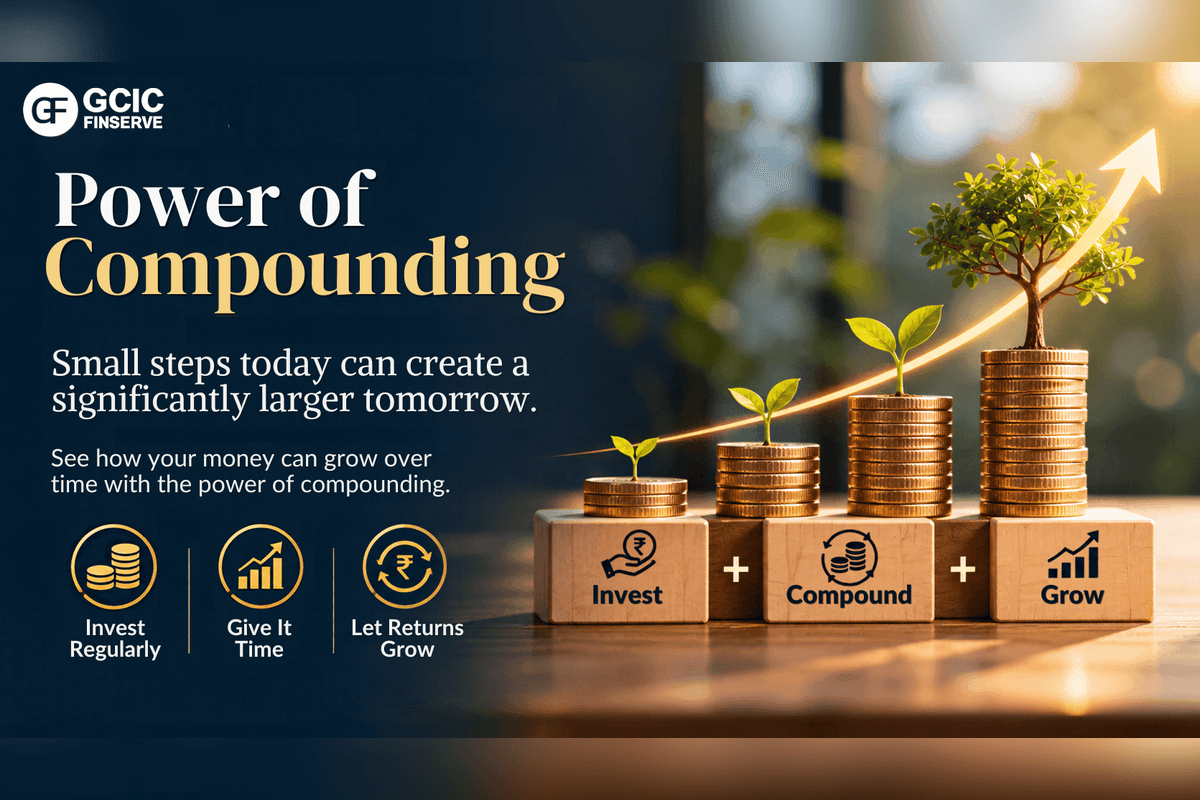
What if the money you invest today could generate returns, and those returns could potentially generate further returns in the future? This is the basic idea behind the Power of Compounding.
Compounding is one of the most important concepts in long-term financial planning. It allows an investment to grow not only through the original amount invested but also through the returns accumulated over time.
Whether you are a first-time investor or someone working towards long-term financial goals, understanding compounding can help you appreciate why starting early, investing regularly, and staying invested may make a meaningful difference.
With the GCIC Finserve Power of Compounding Tool, you can explore how your money may grow over different time periods and understand the impact of compounding through illustrative calculations.
What Is the Power of Compounding?
The Power of Compounding refers to the process in which returns earned on an investment are added to the original investment, and future returns are then calculated on the accumulated amount.
In simple terms, you can earn returns on:
- Your original investment.
- The returns accumulated from previous periods.
This creates a compounding effect over time.
For example, suppose you invest ₹1,00,000 at an assumed annual compound rate of 10%.
At the end of the first year, the investment grows by ₹10,000, taking the value to ₹1,10,000.
In the second year, the assumed 10% growth is calculated on ₹1,10,000 rather than just the original ₹1,00,000. This means the growth for the second year is ₹11,000.
Over time, the accumulated amount can grow at an increasing pace because returns are added to the investment base.
How Does Compounding Work?
Compounding works by reinvesting accumulated returns so that the investment base can increase over time.
Consider this illustrative example:
Initial investment: ₹1,00,000
Assumed annual return: 10%
Investment period: 20 years
Compounding frequency: Annual
| Year | Illustrative investment value |
|---|---|
| Starting amount | ₹1,00,000 |
| After 5 years | ₹1,61,051 |
| After 10 years | ₹2,59,374 |
| After 15 years | ₹4,17,725 |
| After 20 years | ₹6,72,750 |
In this illustration, an initial investment of ₹1 lakh grows to approximately ₹6.73 lakh over 20 years, assuming a constant annual compound rate of 10% and no additional investments or withdrawals.
The example demonstrates how time and reinvested returns can influence investment growth.
Actual investment returns may fluctuate, particularly in market-linked investments, and will not necessarily follow a fixed annual growth rate.
Simple Interest vs Compound Interest: What Is the Difference?
Simple interest and compound interest calculate returns differently.
Simple interest is calculated only on the original principal amount.
Compound interest is calculated on the principal as well as the accumulated returns from previous periods.
Consider an illustrative investment of ₹1,00,000 at 10% annually for 20 years.
| Particulars | Simple interest | Compound interest |
|---|---|---|
| Initial investment | ₹1,00,000 | ₹1,00,000 |
| Assumed annual rate | 10% | 10% |
| Investment period | 20 years | 20 years |
| Total value | ₹3,00,000 | Approximately ₹6,72,750 |
The difference comes from the way returns are calculated. With simple interest, the return is based on the original principal. With annual compounding, accumulated returns also become part of the amount on which future returns are calculated.
Why Does Starting Early Matter?
Time is one of the most important factors in compounding.
When you start investing early, your money has a longer period in which accumulated returns can potentially generate further returns.
Consider two hypothetical investors:
- Investor A starts investing at age 25.
- Investor B starts investing at age 35.
Both investors may have similar financial goals, but Investor A has an additional ten years for investments to remain invested and potentially compound.
This does not guarantee a higher return, but a longer investment period can create more opportunities for compounding to work.
Starting early may also encourage disciplined financial habits and give investors more time to work towards long-term goals.
Five Factors That Influence the Power of Compounding
The potential impact of compounding depends on several factors.
1. Initial Investment Amount
The amount invested at the beginning forms the base for future growth. A larger initial investment can result in a larger accumulated value, assuming the same return and investment period.
2. Rate of Return
The rate of return influences how quickly an investment may grow.
However, higher potential returns generally involve higher investment risks. Do not assume that a particular return rate will be achieved every year.
3. Investment Duration
The longer an investment remains invested, the more time accumulated returns have to potentially generate further returns.
This is why the duration of an investment is an important part of long-term financial planning.
4. Regular Contributions
Investing regularly can help build an investment corpus over time.
For example, a monthly Systematic Investment Plan (SIP) allows investors to contribute a chosen amount at regular intervals. Each contribution gets its own period to potentially grow and compound.
5. Reinvestment of Returns
Compounding becomes possible when returns or earnings are retained or reinvested rather than withdrawn.
The treatment of returns depends on the investment product and its structure.
How Does Compounding Work in Mutual Fund Investments?
Mutual funds can provide exposure to different asset classes depending on the scheme's investment objective.
In mutual fund investing, the growth potential of an investment depends on factors such as the underlying securities, market conditions, investment duration, expenses and the scheme's performance.
For example, an investor may choose to invest through a Growth option, where the scheme's income is retained and reflected in its NAV, subject to market movements and applicable expenses.
A SIP can also help investors contribute regularly towards long-term financial goals.
However, mutual fund returns are market-linked. They are not fixed interest payments, and compounding illustrations should not be interpreted as guaranteed returns.
How to Use the GCIC Finserve Power of Compounding Tool
Understanding compounding becomes easier when you can see how different assumptions affect the potential future value of an investment.
The GCIC Finserve Power of Compounding Tool helps you explore how your money may grow over time.
You can use the tool to understand the impact of compounding through illustrative calculations.
Follow these steps:
- 1Visit the GCIC Finserve Power of Compounding Tool.
- 2Enter the relevant investment details requested by the calculator.
- 3Select the assumed rate of return, wherever applicable.
- 4Choose the investment duration.
- 5Calculate the projected growth.
- 6Review the estimated future value and understand how the assumptions affect the result.
You can experiment with different investment amounts, return assumptions and time periods to compare potential outcomes.
Try the tool here:Power of Compounding Calculator – GCIC Finserve
Remember that calculator results are illustrative estimates, not predictions of actual investment performance.
Common Mistakes That Can Reduce the Benefits of Compounding
Even when investors understand compounding, certain habits can affect their long-term investment journey.
1. Delaying the Start of Investing
Waiting too long to begin investing can reduce the time available for accumulated returns to grow.
2. Frequently Withdrawing Investments
Withdrawing accumulated investments can reduce the amount that remains invested and potentially compounds in the future.
3. Expecting Fixed Returns
Market-linked investments do not generate guaranteed or identical returns every year. Avoid relying on unrealistic return assumptions.
4. Ignoring Investment Risk
The potential benefits of compounding should not lead investors to overlook market risk, liquidity requirements or their financial capacity.
5. Stopping Regular Investments Without Reviewing Goals
Changes in income and financial responsibilities may affect your ability to invest. Review your financial goals and investment approach rather than making decisions only because of short-term market movements.
How Can You Build Better Long-Term Investment Habits?
You do not necessarily need a large amount of money to begin developing an investment habit.
Some practical steps include:
- Set clear financial goals.
- Decide how much you can reasonably invest.
- Understand your risk tolerance.
- Consider a suitable investment horizon.
- Explore regular investment methods such as SIPs.
- Review your investments periodically.
- Avoid making decisions based only on short-term market movements.
- Increase contributions when your financial circumstances allow.
Consistency and a well-considered investment approach can help you work towards long-term financial goals.
Explore More Investment Tools from GCIC Finserve
Understanding compounding is one part of financial planning. You can also explore other GCIC Finserve resources to learn about investment growth and mutual fund concepts.
- Power of Compounding Tool
- SIP Calculator
- Mutual Fund Risk Profiler
- Latest Mutual Fund NAV
- Scheme Performance Tracker
Investors in South Delhi, Greater Kailash, Defence Colony, South Extension, Lajpat Nagar and across Delhi NCR can use these resources to improve their understanding of investment concepts.
Conclusion
The Power of Compounding highlights why time, consistency, and reinvestment can play an important role in long-term investment growth.
Small, disciplined steps taken today may contribute towards larger financial goals over time. While compounding cannot remove investment risk or guarantee returns, understanding how it works can help investors make more informed financial decisions.
Explore the GCIC Finserve Power of Compounding Tool and see how different investment amounts, return assumptions, and time periods can influence your estimated future wealth.
Frequently Asked Questions
Disclaimer: Mutual Fund investments are subject to market risks. Read all scheme-related documents carefully before investing. Past performance is not indicative of future returns, and returns are not guaranteed. All examples and calculator illustrations in this article are for educational purposes only and are based on stated assumptions. Actual investment returns may vary depending on market conditions, investment choices, expenses, taxes, and other factors. This article is for general educational and informational purposes only and does not constitute investment advice or a recommendation to buy, hold or sell any financial product. GCIC Finserve Limited is an AMFI-registered Mutual Fund Distributor (ARN-272705), not a SEBI-registered Investment Adviser.
Related Insights & Market Perspectives
Latest Mutual Fund NAV: How to Check NAV and Daily Changes
Strategic market intelligence covering asset allocation, economic indicators, and wealth structuring principles.
Scheme Performance Tracker: How to Compare Mutual Fund Performance
Learn how to use a Scheme Performance Tracker to compare mutual fund scheme performance, review historical returns and understand key factors before investing.
SIP vs Lump Sum Investment: Which Is Better for Investors in South Delhi?
Understand SIP vs Lump Sum Investment, their benefits, risks and differences. Explore which approach may suit your financial goals in Delhi NCR