

SIP Calculator: See How Your Money Can Grow Over Time
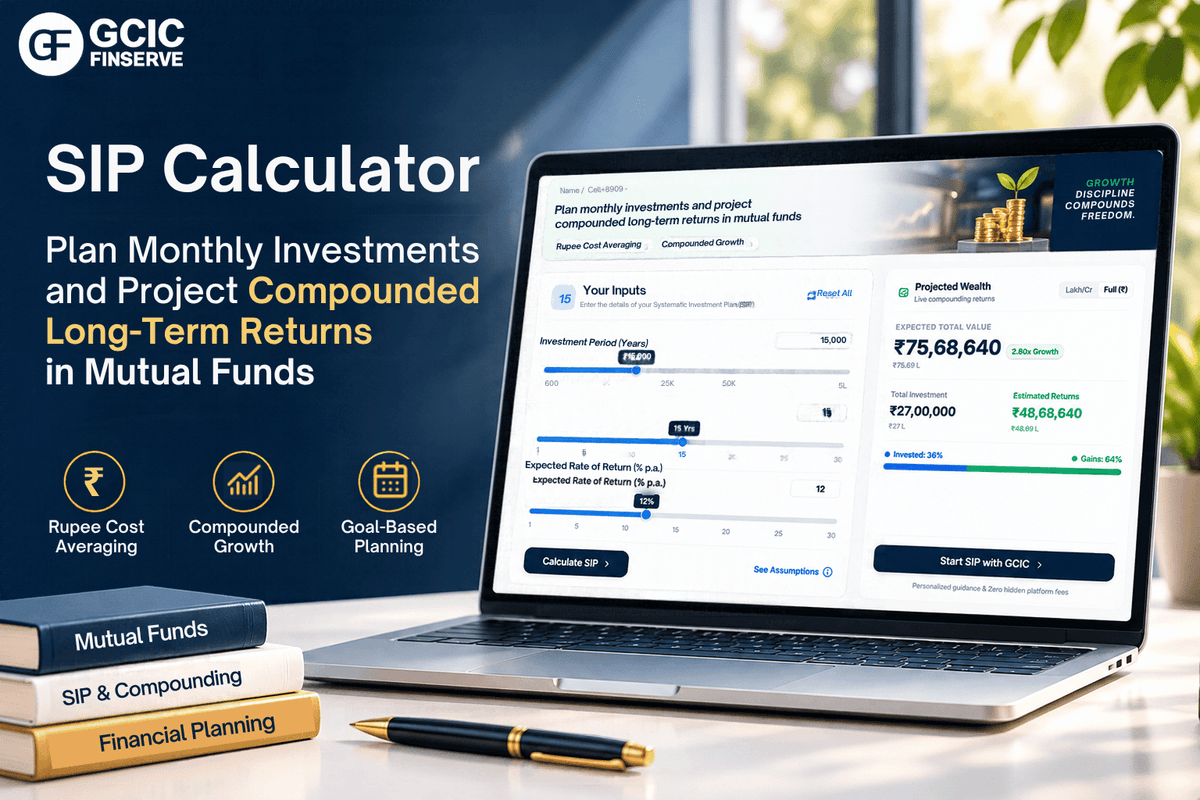
Have you ever wondered how a small monthly investment could grow into a substantial amount over time?
Many people want to invest but are unsure how much they should invest, how long they should continue, or what their money might be worth in the future.
This is where a SIP Calculator can help.
A Systematic Investment Plan (SIP) allows you to invest a fixed amount in a mutual fund scheme at regular intervals, usually monthly. A SIP Calculator helps estimate the potential future value of these investments based on your monthly contribution, investment duration and assumed rate of return.
Whether you are starting with ₹1,000 or planning to invest ₹10,000 every month, understanding how your money may grow can help you make more informed financial decisions.
What Is a SIP Calculator?
A SIP Calculator is an online financial tool that estimates the potential value of your mutual fund investments over a selected period.
You generally need to enter three details:
- Monthly Investment: The amount you plan to invest every month.
- Investment Duration: How many years you intend to continue investing.
- Expected Annual Return: An assumed annual rate of return used for estimation.
Based on these inputs, the calculator estimates your total investment, potential returns and estimated maturity value.
It is important to understand that these results are only illustrative. Mutual fund returns are market-linked and are not guaranteed.
Try the GCIC SIP Calculator
Want to estimate how your monthly investment could grow over time?
Use the GCIC SIP Calculator to enter your monthly investment amount, investment duration and assumed rate of return.
Explore different scenarios and understand the estimated future value of your investments.
Remember: Calculator results are illustrative. Actual mutual fund returns may be higher or lower and are not guaranteed.
How Does a SIP Calculator Work?
A SIP Calculator uses a mathematical formula to estimate the future value of regular investments.
The commonly used formula is:
FV = P × [((1 + r)ⁿ − 1) / r] × (1 + r)
Where:
- FV: Future value of the investment
- P: Monthly investment amount
- r: Monthly rate of return (annual assumed rate divided by 12)
- n: Total number of monthly instalments
The calculation assumes that investments are made at the end of each month.
For example, suppose you invest ₹5,000 every month for 10 years and assume an annual return of 10%.
The calculator estimates how much your investment could be worth at the end of the period.
The actual outcome will depend on market performance and the mutual fund scheme's returns.
SIP Calculator Example: What Can ₹5,000 Per Month Become?
Let's understand this with a simple example.
Suppose you invest ₹5,000 every month and continue your SIP for different periods, assuming an annual return of 10%.
| Investment Period | Total Amount Invested | Estimated Value |
|---|---|---|
| 5 Years | ₹3,00,000 | ₹3,87,000 |
| 10 Years | ₹6,00,000 | ₹10,24,000 |
| 15 Years | ₹9,00,000 | ₹20,72,000 |
| 20 Years | ₹12,00,000 | ₹37,97,000 |
Illustrative estimates only. Calculations assume a 10% annual rate of return, converted to a monthly rate, with monthly investments made at the end of each month. Figures are rounded. Actual returns will vary with market conditions and are not guaranteed.
Notice how the estimated value increases over longer investment periods.
This illustrates the potential impact of compounding and staying invested over time. However, it does not mean that mutual funds will deliver a fixed or consistent return every year.
Why Is a SIP Calculator Useful?
A SIP Calculator can make financial planning easier by helping you understand different investment scenarios.
1. Helps Estimate Future Value
You can get an approximate idea of how much your regular investments may grow over a selected period.
2. Helps Plan Monthly Investments
If you have a financial goal, you can experiment with different monthly investment amounts and durations to understand what may be required.
3. Makes Compounding Easier to Understand
Compounding allows potential returns to generate further returns over time. A calculator helps illustrate how the investment period can affect the estimated future value.
4. Helps Compare Different Scenarios
You can change the monthly investment amount, duration, or assumed return to see how the estimates change.
5. Supports Goal-Based Financial Planning
Whether you are planning for education, retirement, a home purchase, or another long-term goal, an SIP Calculator can help you explore possible investment scenarios.
SIP vs Lumpsum: What Is the Difference?
Both SIP and lumpsum are ways of investing in mutual funds, but they work differently.
| Feature | SIP | Lumpsum |
|---|---|---|
| Investment Method | Regular investments | One-time investment |
| Investment Amount | Fixed or chosen periodically | Invested in one go |
| Market Exposure | Investments happen at different market levels | The entire amount is invested at one time. |
| Suitable For | People investing regularly from income | Investors with an available amount to invest |
| Investment Planning | Supports regular investing habits | Requires planning for a larger investment |
Neither method guarantees better returns.
The suitability of SIP or lumpsum investing depends on your financial goals, investment horizon, risk tolerance, and available funds.
What Is a Step-Up SIP?
A Step-Up SIP allows you to increase your monthly investment amount periodically.
For example, suppose you start with a monthly SIP of ₹5,000 and increase it by ₹500 every year.
Your monthly contribution would look like this:
- Year 1: ₹5,000 per month
- Year 2: ₹5,500 per month
- Year 3: ₹6,000 per month
- Year 4: ₹6,500 per month
This example uses a fixed ₹500 annual increase, not a percentage increase.
A Step-Up SIP may be useful for individuals whose income increases over time and who want to gradually increase their investments.
However, any increase should be considered in the context of your income, expenses, emergency savings and financial goals.
Things to Remember Before Using a SIP Calculator
A SIP Calculator is a planning tool, not a prediction of actual investment performance.
Keep these points in mind:
- Returns are not guaranteed: Mutual fund investments are subject to market risks.
- Assumed returns are not actual returns: The rate entered into a calculator is only an assumption.
- Market conditions change: Actual investment performance may fluctuate.
- Investment duration matters: A longer investment period may provide more time for compounding, but it does not remove market risk.
- Review your financial goals: Your investment amount and duration should be aligned with your changing financial circumstances.
A calculator can help you understand possibilities, but investment decisions should not be based on estimated returns alone.
A SIP Calculator can help you explore how different investment amounts and durations may affect your potential future wealth. It can be a useful starting point for understanding long-term investment planning.
At GCIC Finserve Limited, we believe financial decisions should be supported by awareness, clarity, and an understanding of investment risks.
Explore our Mutual Fund Services orcontact our team to learn more about mutual fund distribution services.
Frequently Asked Questions
Disclaimer: This article is for educational and informational purposes only. It should not be considered investment advice or a recommendation to buy, sell, or hold any mutual fund scheme. Investments are subject to market risks, including possible loss of capital. Past performance does not guarantee future returns. SIP calculations and examples are illustrative and do not represent actual or assured returns. GCIC Finserve Limited is an AMFI-registered Mutual Fund Distributor (ARN-272705), not a SEBI-registered Investment Adviser. Mutual Fund investments are subject to market risks. Read all scheme-related documents carefully before investing.
Related Insights & Market Perspectives
The Next Big Investment Opportunities After AI
Explore investment opportunities after AI in India, including energy, semiconductors, robotics and healthcare. Understand key trends and risks.
Gold vs Equity: Where Should Investors Look for Opportunities?
Gold vs Equity in 2026: Compare risks, returns, market trends, and key differences to understand how both assets fit into a diversified investment portfolio.
The Gold-Only Family Portfolio: Why Putting All Your Wealth in One Asset Can Be Risky
Discover why a gold-only family portfolio can be risky. Understand gold investment risks, hidden costs and the importance of diversification.