
What Is KYC and Why Is It Important for Investors?
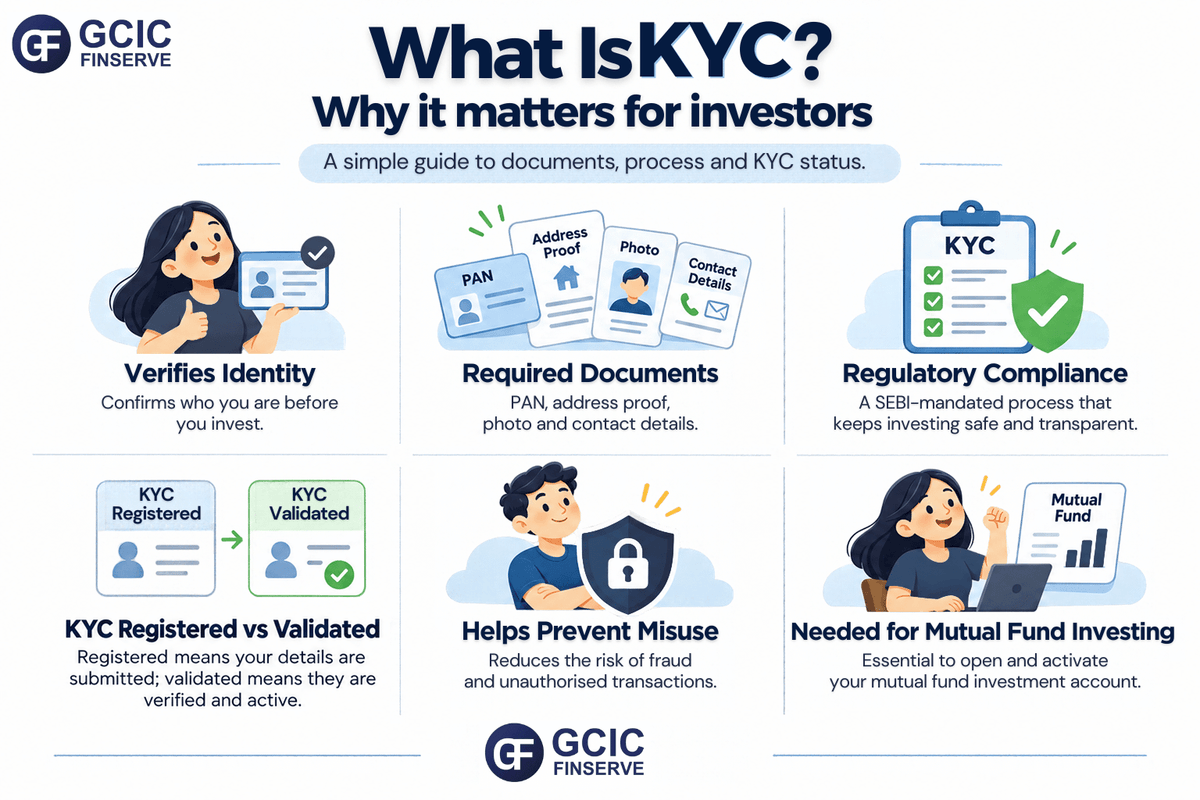
What is KYC, why is it needed, and what happens if your KYC is incomplete?
Before opening a bank account, investing in mutual funds or accessing certain financial services in India, you may be required to complete a process known as KYC (Know Your Customer).
KYC is an identity-verification and customer due-diligence process through which regulated financial institutions establish and verify information about their customers.
For investors, KYC plays an important role in regulatory compliance, identity verification, and maintaining accurate financial records.
Whether you are a first-time investor in Delhi NCR or already hold mutual fund investments, understanding KYC can help you navigate account opening, document submission, and verification requirements.
This article explains what KYC means, why it is important, the documents commonly required, how verification works, and what different KYC statuses mean for investors in India.
What Is KYC?
KYC stands for Know Your Customer. It is a regulatory process used by financial institutions and intermediaries to verify a customer's identity and relevant personal information before providing certain financial services.
The process generally involves collecting and verifying details such as:
- Full name
- Date of birth
- Permanent Account Number (PAN), where applicable
- Residential or correspondence address
- Proof of identity
- Contact information
- Other information required under applicable regulations
The specific details and verification procedures depend on the institution, type of customer, and financial service involved.
In the Indian securities market, KYC requirements operate under the regulatory framework established by the Securities and Exchange Board of India (SEBI), together with applicable anti-money-laundering requirements.
Banks and other financial institutions may follow additional or different requirements prescribed by their respective regulators.
In simple terms: KYC helps regulated financial institutions establish who their customers are before providing services.
What Is the Full Form of KYC?
The full form of KYC is Know Your Customer.
The expression "Know Your Client" is also used in certain securities market contexts.
Both refer to processes intended to establish and verify customer identity and support regulatory compliance.
Why Is KYC Important for Investors?
KYC is an important part of India's financial regulatory framework.
It supports several functions relating to identification, record-keeping, and regulatory compliance.
Identity Verification
KYC helps financial institutions establish that the person opening an account or requesting a service is identifiable through accepted documentation and verification procedures.
This can reduce the risk of accounts being opened with inaccurate or fraudulent identity information.
Regulatory Compliance
Financial institutions and securities market intermediaries must follow applicable customer identification, due diligence, and anti-money laundering requirements.
KYC supports these legal obligations.
Prevention of Financial Misuse
KYC forms part of broader measures intended to address money laundering, identity misuse, and other unlawful activities.
However, completing KYC does not guarantee that fraud or financial misuse cannot occur.
Accurate Investor Records
KYC helps institutions maintain essential customer information.
Accurate records can support account maintenance, investor communications, and regulatory reporting.
Access to Regulated Investment Services
For mutual fund investors, completing the applicable KYC requirements is a prerequisite to investing.
Incomplete, deficient, or rejected KYC records can create difficulties with account opening and permitted transactions.
Key takeaway: KYC is a regulatory identification process. It is not an investment product and does not determine whether an investment is suitable or profitable.
Is KYC Mandatory for Mutual Fund Investors in India?
Yes. KYC compliance is mandatory for mutual fund investments in India, subject to the applicable regulatory requirements.
Investors are required to meet the prescribed KYC conditions regardless of whether they intend to invest a small or large amount.
This requirement applies to investments made through eligible methods, including:
- One-time mutual fund investments
- Systematic Investment Plans (SIPs)
- Other permitted mutual fund transaction arrangements
However, the ability to complete a transaction depends on the investor's KYC status and applicable rules.
An existing investor with a registered KYC record may face different requirements from someone approaching a new intermediary.
Also, completing KYC does not mean a mutual fund investment has been approved as suitable for the investor.
KYC compliance and investment suitability are separate matters.
What Documents Are Required for KYC in India?
The documents required depend on the investor category, financial institution, verification method, and applicable regulatory provisions.
For individual investors, the following information is commonly requested.
| Document or information | General purpose |
|---|---|
| PAN, where applicable | Identification and regulatory verification |
| Proof of identity | Establishing customer identity |
| Proof of address | Confirming residential or correspondence details |
| Photograph, where required | Customer identification |
| Mobile number and email address | Communication and applicable verification |
| Additional information | Meeting relevant customer due diligence requirements |
Is PAN Required for KYC?
PAN is generally required for mutual fund and securities market transactions, subject to specified exemptions.
Investors should ensure that the PAN information provided matches their relevant identification records.
Certain verification and PAN-Aadhaar linking requirements may apply depending on the investor's circumstances and current rules.
Is Aadhaar Mandatory for KYC?
Aadhaar is an important identity document and can be used through permitted verification processes.
However, Aadhaar-based authentication should not be assumed to be the only legally permitted route for every KYC application.
Other officially valid documents and accepted verification procedures may be available, subject to the applicable framework.
The documents accepted for completing KYC and the conditions for receiving KYC Validated status may differ.
A KYC record does not automatically become validated merely because an accepted identification document was submitted.
Investors should verify the current documentation and validation requirements through an authorised intermediary or KYC registration agency.
Is Address Proof Required?
Address verification is generally an important part of the customer identification process.
Accepted proof-of-address documents and verification methods are specified under the applicable KYC procedures.
Can Additional Information Be Required?
Yes.
Depending on the investor and institution, additional information may include:
- Occupation
- Income-related details
- Tax residency information
- Politically exposed person status
- Other applicable customer due-diligence details
Important: This is a general overview, not an exhaustive list of documents. The relevant financial institution or KRA should be consulted for current requirements.
How Does the KYC Verification Process Work?
KYC can be completed through eligible physical or electronic methods, depending on the institution and regulatory framework.
The process generally includes the following stages.
Submit the KYC Information
The applicant provides the required information through the applicable KYC or account-opening form.
Details may include name, PAN, address, and registered contact information.
Provide Supporting Documents
Accepted identification and address documents are submitted using the prescribed method.
The institution may require document certification or verification against original records.
Complete Identity Verification
Depending on the permitted process, verification may involve:
- In-person verification
- Eligible electronic authentication
- Video-based identity verification
- Other approved procedures
Not every method is available to every investor.
Processing of KYC Records
For securities market participants, KYC information is processed through the relevant registration infrastructure.
A KYC registration agency may verify or validate the required information under the applicable SEBI framework.
Check the KYC Status
After processing, investors can check their KYC status through official channels.
If discrepancies or missing information are identified, additional documentation or corrective action may be necessary.
Update Records When Required
Investors should update relevant information when important personal or contact details change.
Investor note: KYC verification is not necessarily instant. Processing times depend on documentation, verification checks, the institution, and any outstanding deficiencies.
Physical KYC vs eKYC: What Is the Difference?
KYC may be completed through physical or eligible electronic procedures.
| Feature | Physical KYC | eKYC |
|---|---|---|
| Application | Paper-based or assisted process | Eligible electronic process |
| Document submission | As prescribed for physical verification | Digitally submitted or authenticated |
| Identity checks | Applicable physical or in-person verification | Approved electronic or video-based methods |
| Availability | Depends on institution | Depends on eligibility and institution |
| Purpose | Identity verification and compliance | Identity verification and compliance |
Both approaches are intended to fulfill applicable customer identification requirements.
Electronic verification may simplify certain steps, but availability and completion depend on the permitted process and successful verification.
KYC Registered vs KYC Validated: What Is the Difference?
When checking their KYC records, investors may encounter different status descriptions.
These statuses can affect whether additional verification or documentation is required.
| KYC status | General meaning |
|---|---|
| KYC Validated | Required KYC attributes have been validated under the applicable framework. |
| KYC Registered | KYC record is registered, but additional KYC may be needed when approaching another intermediary. |
| KYC On-Hold / Rejected | The record has an unresolved deficiency or verification issue. |
What Does KYC-Validated Mean?
KYC Validated indicates that the required information has been validated under the applicable KRA framework.
Validated records generally support portability across eligible securities market intermediaries.
This means that an investor may not have to repeat the full KYC process when approaching another eligible intermediary, subject to applicable requirements.
Additional information or checks may still be requested where required.
What Does KYC Registered Mean?
KYC Registered indicates that the investor's KYC record is registered.
However, this status does not necessarily provide the same portability as KYC validated.
An investor approaching a new securities market intermediary may have to complete additional or fresh KYC documentation.
Existing investors may generally continue eligible transactions through their existing intermediary, subject to applicable requirements.
What Does KYC On-Hold or Rejected Mean?
A KYC record may be placed on hold or rejected because of issues such as:
- Incomplete documentation
- Inaccurate identification details
- Unsuccessful verification of required information
- Other deficiencies identified during KYC processing
Investors with these statuses may face restrictions on certain transactions until the relevant requirements are met.
The precise implications depend on the current regulatory framework and investor circumstances.
Certain transactions, including permitted exits from existing investments, may be subject to specific regulatory provisions and due-diligence requirements.
Important: Investors should check the reason for their KYC status and the corrective steps required through the relevant authorised KRA or intermediary.
What Is a KYC Registration Agency (KRA)?
A KYC Registration Agency (KRA) is an entity registered under SEBI's framework to maintain and process KYC records for securities market participants.
KRAs help support:
- Registration of KYC information
- Verification and validation of relevant attributes
- Maintenance of KYC records
- Permitted sharing of records with eligible intermediaries
- Communication of relevant KYC status information
This infrastructure can help reduce duplication in customer identification procedures.
However, additional verification may be required depending on the investor's KYC status.
What Is CKYC?
CKYC stands for Central Know Your Customer.
The Central KYC Records Registry (CKYCR) is a centralised repository for customer identification records in the financial sector.
CERSAI performs the role of the Central KYC Registry.
The framework supports standardisation and permitted reuse of KYC records, subject to applicable requirements.
KYC vs KRA vs CKYC
| Term | Meaning |
|---|---|
| KYC | Customer identification and verification process |
| KRA | Securities market KYC registration infrastructure |
| CKYC | Centralised KYC records framework for the financial sector |
Although these concepts are related, they serve different functions.
How Can Investors Check Their KYC Status?
Mutual fund investors can check their KYC status through official resources.
A general process is:
- 1Visit the official AMFI KYC information page.
- 2Find the available KYC status-check facility.
- 3Follow the instructions of the relevant authorised KRA.
- 4Enter the requested identification information through the secure official interface.
- 5Review the displayed status and any required corrective action.
The exact process may differ depending on the KRA and available verification method.
Important KYC Security Precautions
Investors should:
- Use official websites and authorised intermediaries.
- Avoid sharing OTPs, passwords, or login credentials.
- Be cautious about unsolicited messages requesting KYC updates.
- Verify website addresses before uploading identity documents.
- Report suspicious communication through appropriate official channels.
Remember: KYC verification does not require disclosing account passwords or OTPs to an unknown person offering assistance.
What Happens If KYC Is Incomplete?
Incomplete KYC information can delay account opening or create difficulties with certain investment transactions.
Where a record is rejected or placed on hold, restrictions may apply depending on the applicable framework.
However, not every KYC status has the same implications.
For example:
KYC Registered: Existing investors may generally continue eligible transactions with their existing intermediary, while additional documentation may be required when approaching a new intermediary.
KYC On-Hold or Rejected: Certain transactions may be restricted until the relevant deficiencies are addressed.
The consequences can also depend on the nature of the transaction and specific regulatory provisions.
A KYC issue does not automatically mean that the value of an existing investment has declined.
However, it may affect an investor's ability to carry out certain transactions or access related services.
Investors should consult the relevant authorised KRA or intermediary for the required corrective action.
When Should KYC Details Be Updated?
Investors should review their KYC records when important information changes.
Examples include
- Residential or correspondence address
- Registered mobile number
- Email address
- Name or identification details
- Tax residency information
- Other details relevant to customer due diligence
The applicable procedure and supporting documents depend on the change being requested.
Maintaining accurate information can help reduce communication problems and unnecessary verification delays.
Common KYC Mistakes Investors Should Avoid
Providing Inconsistent Information
Differences between KYC forms and supporting identification records may result in verification difficulties.
Using Outdated Contact Details
Incorrect mobile numbers or email addresses can interfere with important communications and applicable verification requirements.
Ignoring KYC Status Notifications
Investors should review official notifications about incomplete records or additional documentation requirements.
Assuming KYC Never Requires Updating
Changes in customer information or applicable regulations may require updates.
Sharing Sensitive Information Through Unverified Links
Fraudulent messages may misuse the term KYC to request sensitive financial information.
Investors should use secure official channels.
Assuming KYC Approval Means Investment Safety
Completing KYC does not guarantee investment returns, remove market risk or establish whether an investment product is suitable.
GCIC Finserve's Perspective for Delhi NCR Investors
For investors across Delhi NCR, understanding KYC can be an important part of becoming familiar with mutual fund documentation and onboarding procedures.
Accurate identity and contact information can support smoother processing of mutual fund-related administrative requirements.
At GCIC Finserve Limited, our mutual fund distribution services include explaining mutual fund documentation and transaction requirements, assisting with applicable onboarding procedures, and supporting mutual fund-related servicing.
KYC registration, validation, and approval remain subject to the procedures of the relevant authorised entities and applicable regulatory requirements.
Learn More About Mutual Fund Documentation
Visit GCIC Finserve for information about mutual fund distribution services, documentation requirements and investor servicing.
For official information, refer to:
Final Thoughts
So, what is KYC and why is it important for investors?
KYC is a regulatory customer identification and verification process used by financial institutions and intermediaries.
For mutual fund investors, meeting the applicable KYC requirements is an important prerequisite to investing.
Understanding the required documents, verification process, and KYC status can help investors navigate account opening and record updates.
Investors should keep their information accurate, use authorised channels and remain cautious about requests for sensitive financial information.
KYC supports regulated financial transactions, but completing KYC does not eliminate investment risks.
Frequently Asked Questions
Disclaimer: This article is intended for general educational and informational purposes only and does not constitute personalised investment, legal or financial advice. GCIC Finserve Limited is an AMFI-registered Mutual Fund Distributor (ARN-272705), not a SEBI-registered Investment Adviser. KYC requirements and procedures are subject to applicable regulations and may change. KYC completion does not guarantee transaction approval or investment returns. Mutual fund investments are subject to market risks. Please read all scheme-related documents carefully before investing.
Related Insights & Market Perspectives
Large Cap vs Mid Cap vs Small Cap: Which Fund to Choose?
Large cap vs mid cap vs small cap: Understand market capitalisation, investment risks, volatility and key differences before exploring mutual fund options.
Children’s Mutual Funds: Important Things Every Parent Should Know
Children's mutual funds explained for Delhi NCR parents: how they work, lock-in, 2026 SEBI changes, life cycle funds, risks, and tax. Read before investing.
What Is GIFT City? A Simple Guide for Indian Investors (2026)
What is GIFT City and how does GIFT IFSC work? Understand its financial ecosystem, IFSCA regulation and international investment opportunities.